
IGCSE Biology: Gas Exchange in Humans
Complete Cambridge IGCSE Biology guide covering the respiratory system, alveoli, gas exchange, ventilation, inhalation, exhalation and the effects of smoking.
Learning Objectives
Identify the main parts of the human gas exchange system.
Describe the pathway of air into the lungs.
Explain gas exchange at the alveoli.
Describe adaptations of alveoli for efficient gas exchange.
Compare inhalation and exhalation.
Explain the effects of smoking on the lungs.
Human Gas Exchange System
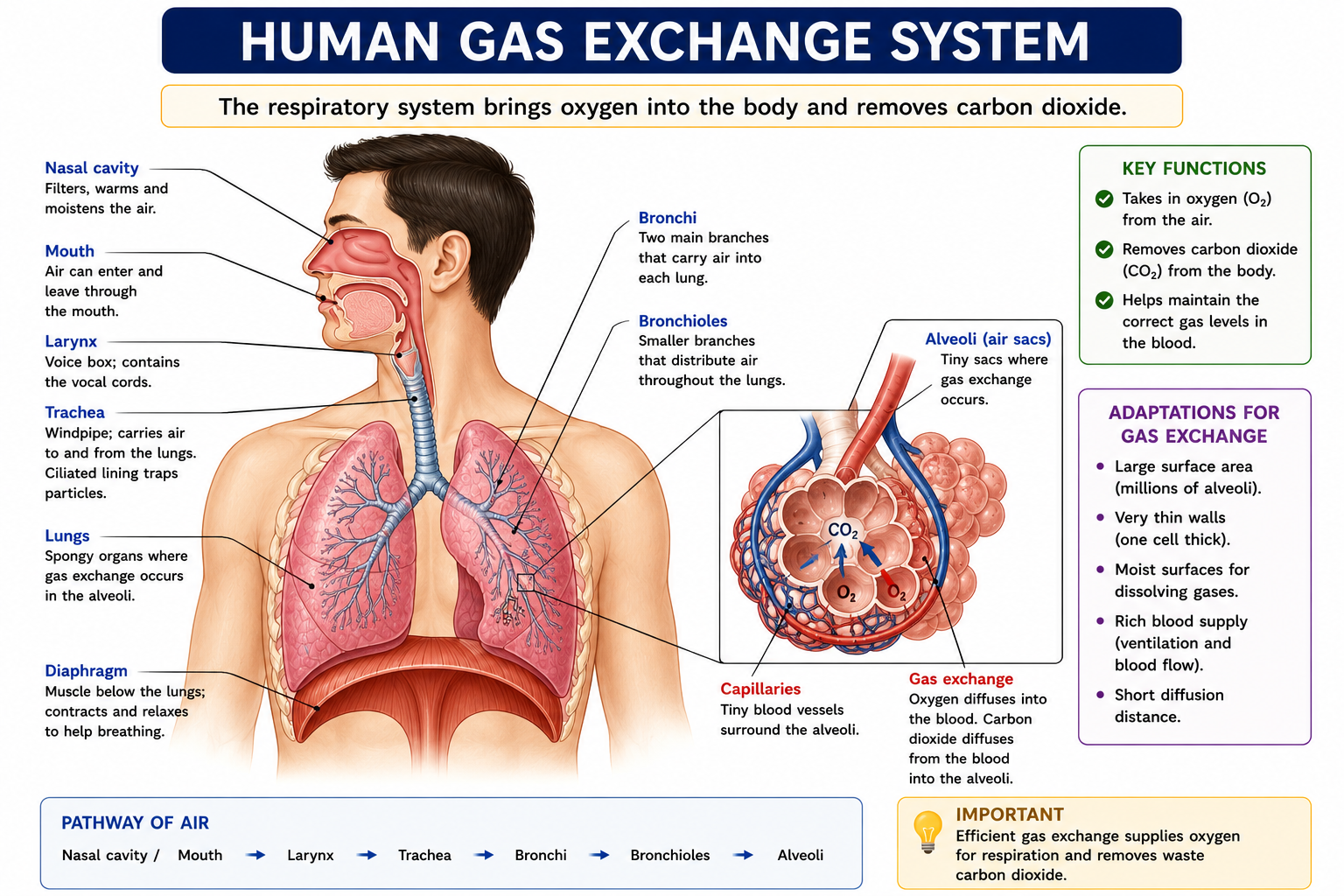
The human gas exchange system brings oxygen into the body and removes carbon dioxide. Oxygen is needed for aerobic respiration, while carbon dioxide is a waste product that must be removed.
| Part | Function |
|---|---|
| Nasal cavity | Filters, warms and moistens the air. |
| Trachea | Carries air towards the lungs. |
| Bronchi | Two main branches carrying air into each lung. |
| Bronchioles | Smaller branches that distribute air inside the lungs. |
| Alveoli | Air sacs where gas exchange occurs. |
| Diaphragm | Muscle involved in ventilation. |
Structure of an Alveolus
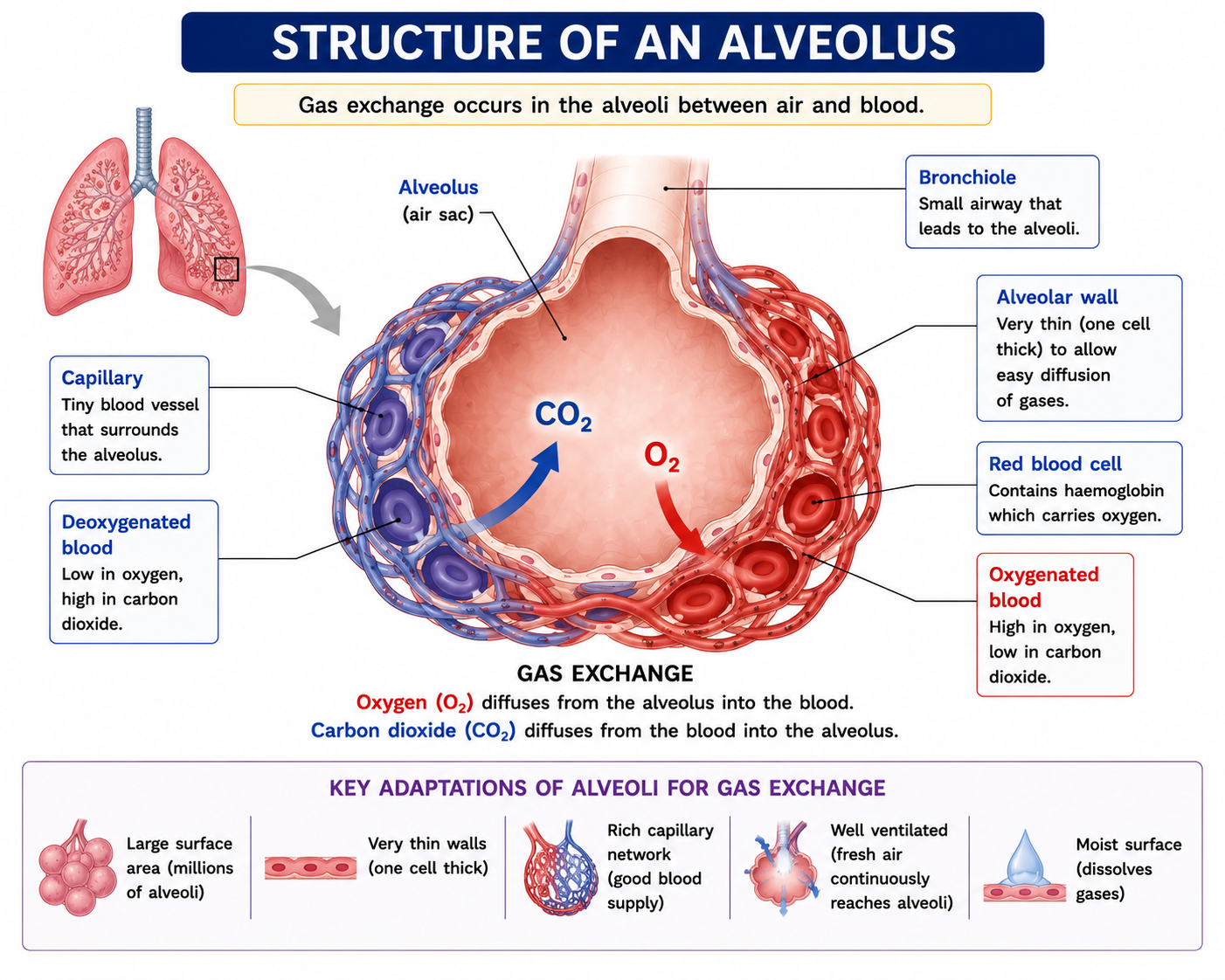
Gas exchange occurs in the alveoli between the air inside the alveoli and the blood in the surrounding capillaries.
Oxygen diffuses from the alveoli into the blood. Carbon dioxide diffuses from the blood into the alveoli.
Adaptations of Alveoli
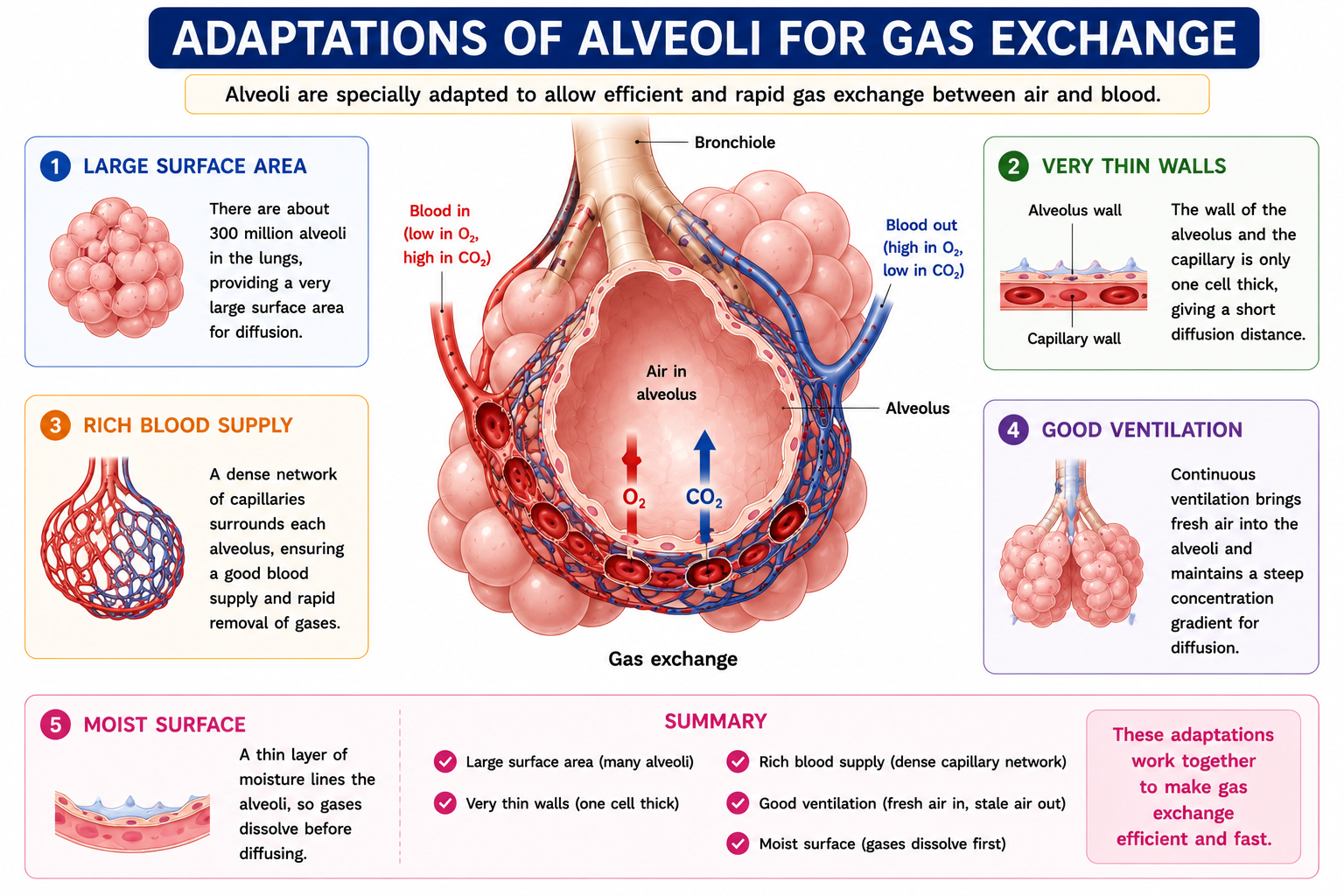
| Adaptation | How It Helps Gas Exchange |
|---|---|
| Large surface area | Many alveoli provide a large area for diffusion. |
| Thin walls | Alveolar and capillary walls are one cell thick, giving a short diffusion distance. |
| Moist surface | Gases dissolve before diffusing. |
| Good blood supply | Maintains a steep concentration gradient. |
| Good ventilation | Brings in oxygen-rich air and removes carbon dioxide-rich air. |
Inhalation and Exhalation
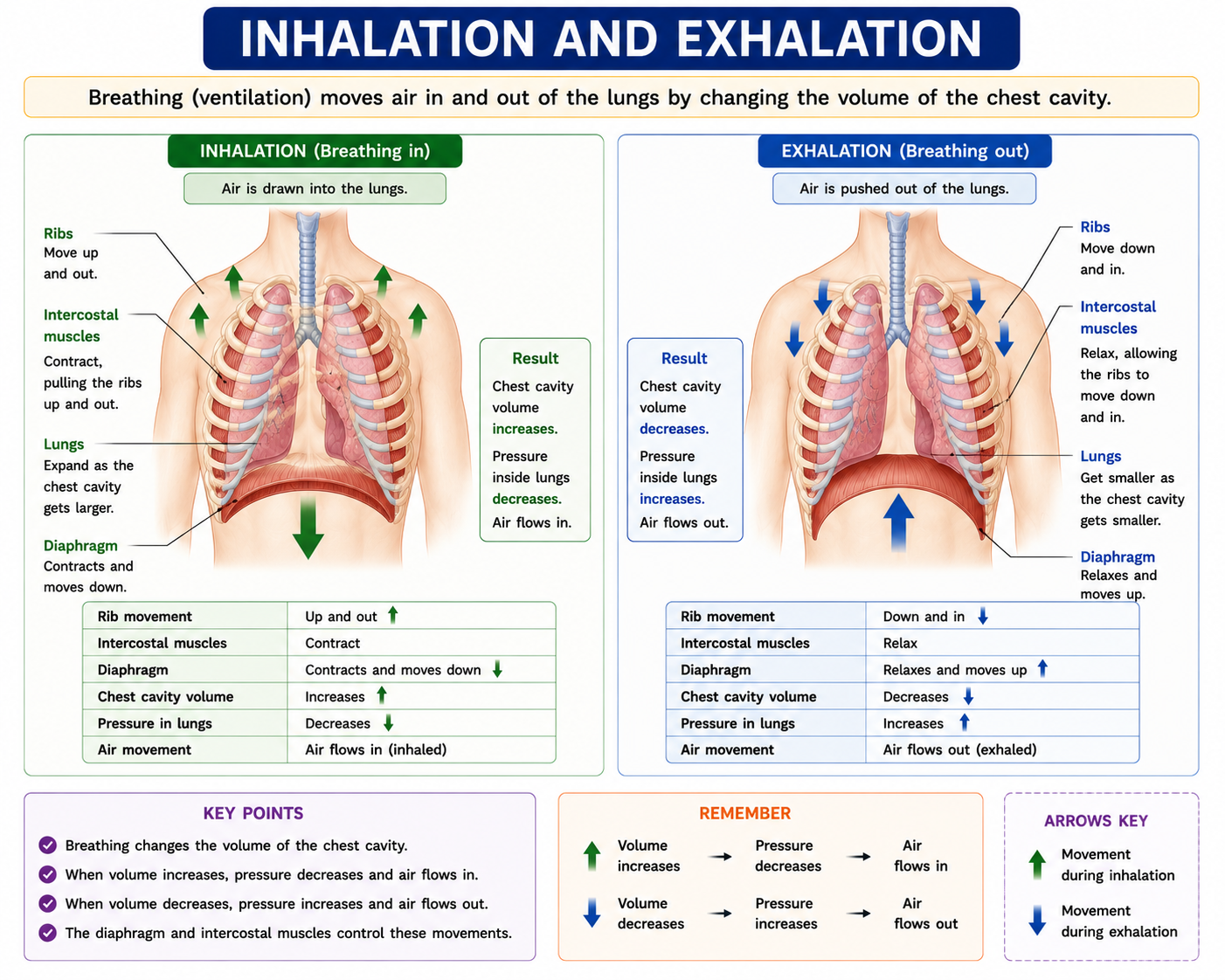
| Feature | Inhalation | Exhalation |
|---|---|---|
| External intercostal muscles | Contract | Relax |
| Ribs | Move up and out | Move down and in |
| Diaphragm | Contracts and flattens | Relaxes and domes upward |
| Chest volume | Increases | Decreases |
| Pressure in lungs | Decreases | Increases |
| Air movement | Air moves into lungs | Air moves out of lungs |
Effects of Smoking on the Respiratory System
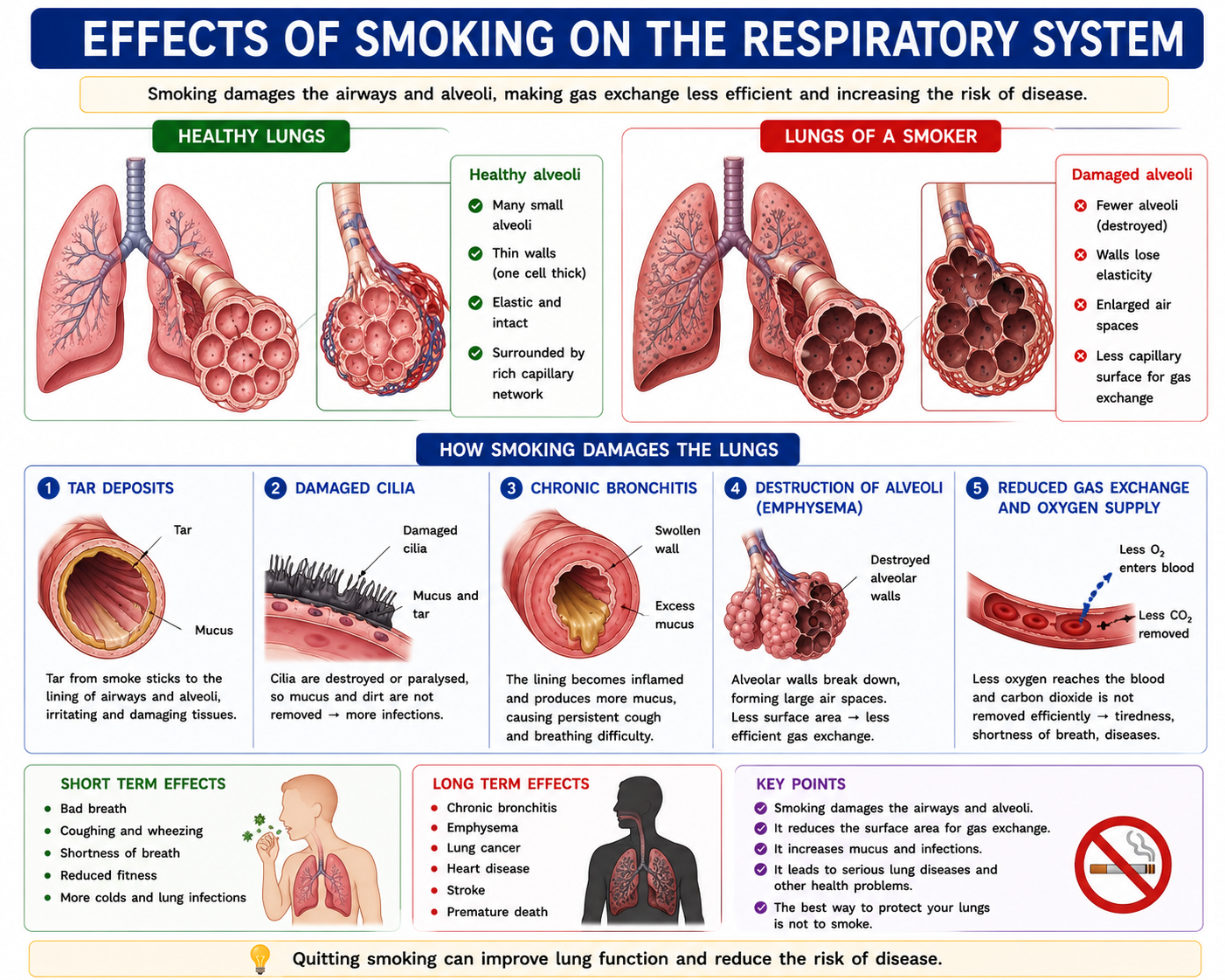
| Harmful Substance / Effect | Impact |
|---|---|
| Tar | Damages cilia and irritates the lining of the airways. |
| Damaged cilia | Mucus and pathogens are not removed effectively, increasing infections. |
| Emphysema | Alveolar walls break down, reducing surface area for gas exchange. |
| Chronic bronchitis | Airways become inflamed and produce excess mucus. |
| Reduced gas exchange | Less oxygen enters the blood and less carbon dioxide is removed. |
Exam Definitions
| Term | Definition |
|---|---|
| Gas exchange | The exchange of oxygen and carbon dioxide between air and blood at the alveoli. |
| Ventilation | The movement of air into and out of the lungs. |
| Alveoli | Tiny air sacs in the lungs where gas exchange occurs. |
| Diffusion | The net movement of particles from a region of higher concentration to a region of lower concentration. |
| Emphysema | A disease where alveolar walls break down, reducing surface area for gas exchange. |
| Bronchitis | Inflammation of the bronchi, often causing excess mucus and coughing. |
Common Exam Mistakes
- Writing that oxygen moves from blood into the alveoli. Oxygen moves from alveoli into blood.
- Forgetting that carbon dioxide moves from blood into the alveoli.
- Saying alveoli have thick walls. They have very thin walls, one cell thick.
- Confusing ventilation with gas exchange.
- Forgetting that high ventilation and blood supply maintain concentration gradients.
- Writing that smoking only affects the lungs; it can also affect the circulatory system.
Exam Style Questions and Answers
1. Define gas exchange.
Gas exchange is the exchange of oxygen and carbon dioxide between air in the alveoli and blood in the capillaries.
2. Where does gas exchange occur in the lungs?
Gas exchange occurs in the alveoli.
3. Explain how alveoli are adapted for gas exchange.
They have a large surface area, thin walls, moist surfaces, good ventilation and a rich blood supply.
4. During inhalation, what happens to the diaphragm?
The diaphragm contracts and flattens, increasing the volume of the chest cavity.
5. Why does air enter the lungs during inhalation?
Chest volume increases, pressure inside the lungs decreases, and air moves in.
6. State two effects of smoking on the lungs.
Smoking damages cilia and can destroy alveolar walls, reducing gas exchange.
7. Explain how emphysema reduces gas exchange.
Alveolar walls break down, reducing surface area and making diffusion of gases less efficient.
8. Why do alveoli need a good blood supply?
A good blood supply maintains a steep concentration gradient for oxygen and carbon dioxide diffusion.
Quick Revision Summary
- The respiratory system brings oxygen into the body and removes carbon dioxide.
- Gas exchange occurs in the alveoli.
- Oxygen diffuses from alveoli into blood.
- Carbon dioxide diffuses from blood into alveoli.
- Alveoli have a large surface area, thin walls, moist surfaces and good blood supply.
- Inhalation increases chest volume and decreases pressure.
- Exhalation decreases chest volume and increases pressure.
- Smoking damages cilia and alveoli.
- Emphysema reduces surface area for gas exchange.