
IGCSE Biology: Transport in Plants
Complete Cambridge IGCSE Biology guide covering xylem, phloem, root hair cells, water uptake, transpiration, translocation and factors affecting transpiration.
Learning Objectives
Describe the functions of xylem and phloem.
Explain water uptake by root hair cells.
Describe the pathway of water through a plant.
Define transpiration and translocation.
Explain factors affecting transpiration.
Understand how a potometer estimates transpiration rate.
Xylem and Phloem
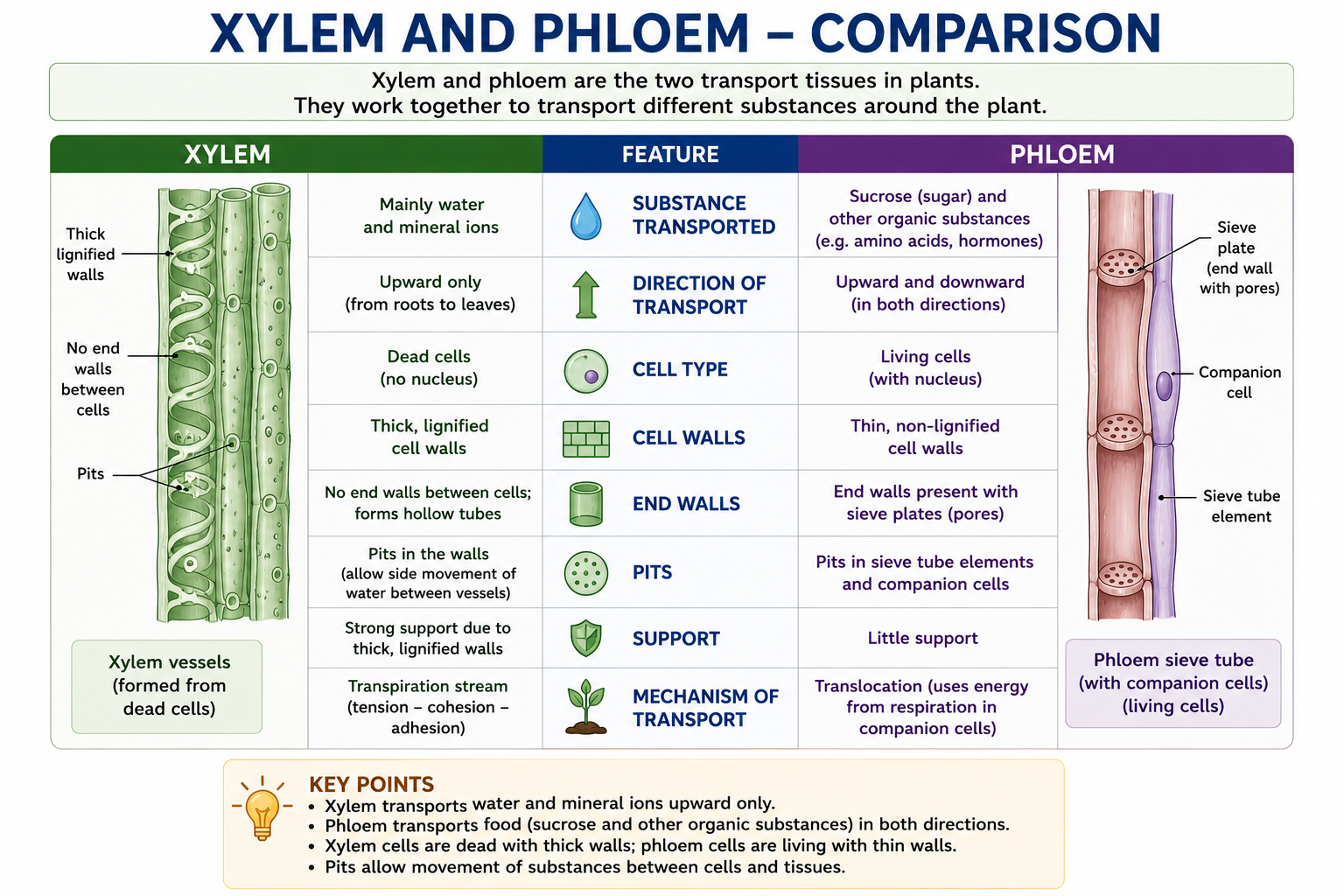
| Feature | Xylem | Phloem |
|---|---|---|
| Substance transported | Water and mineral ions | Sucrose and amino acids |
| Direction | Upwards only | Both upwards and downwards |
| Cells | Dead cells | Living cells |
| Walls | Thick, lignified walls | Thin, non-lignified walls |
| Process | Transpiration stream | Translocation |
Root Hair Cells
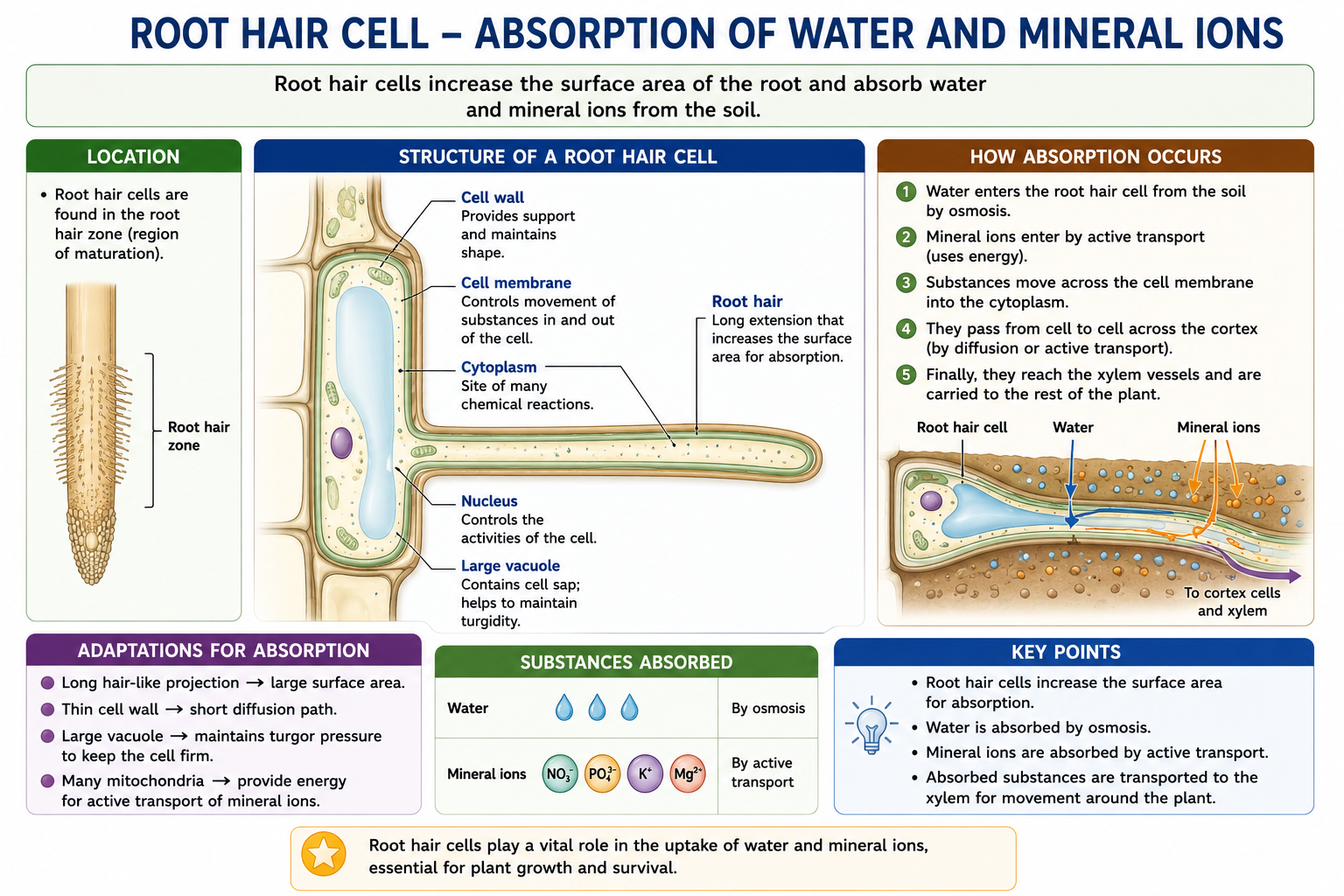
Root hair cells absorb water and mineral ions from the soil.
Water
Enters root hair cells by osmosis.
Enters root hair cells by osmosis.
Mineral ions
Enter by active transport, using energy from respiration.
Enter by active transport, using energy from respiration.
Adaptation
The long root hair gives a large surface area for absorption.
The long root hair gives a large surface area for absorption.
Pathway of Water Through a Plant
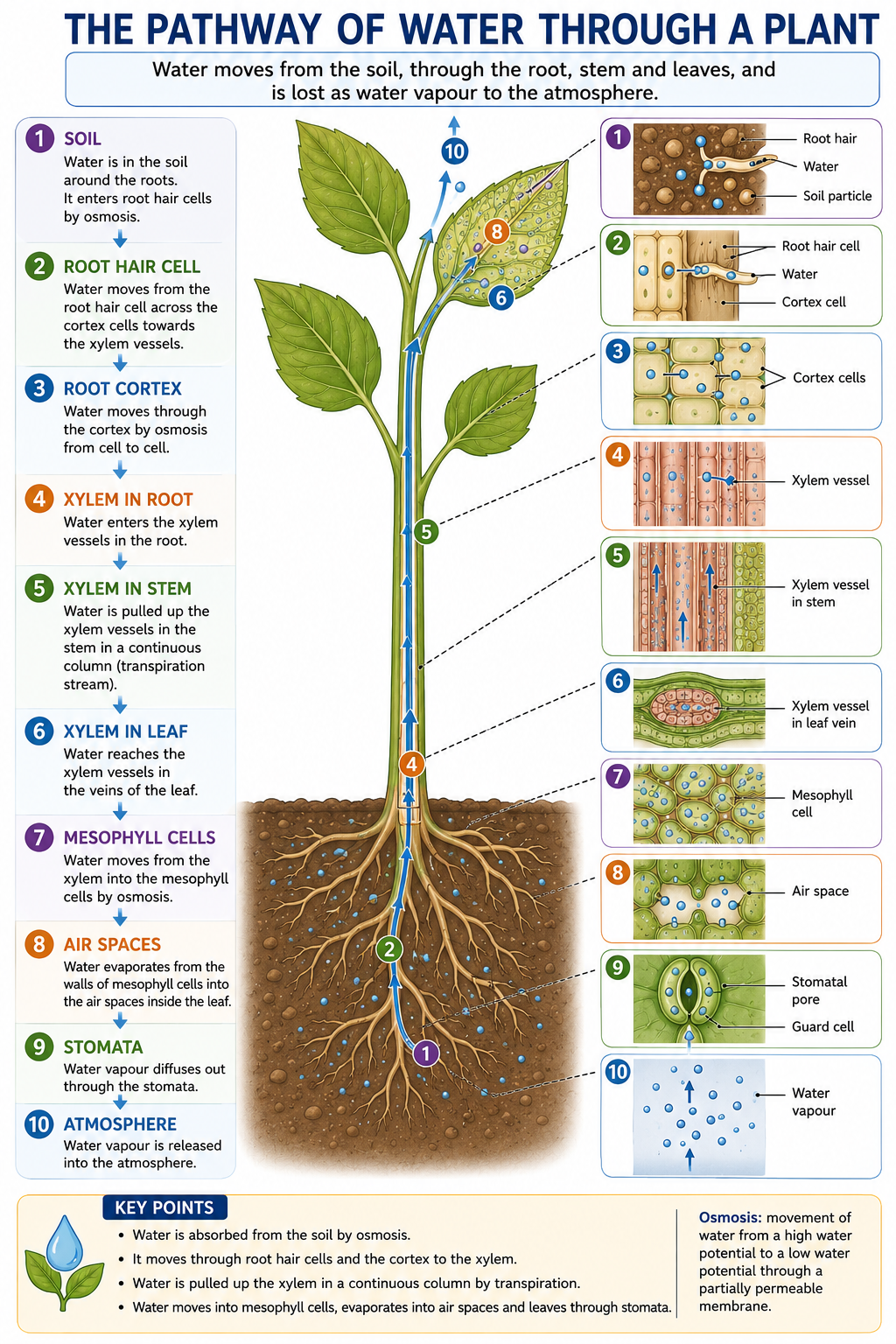
- Water enters root hair cells from the soil by osmosis.
- Water moves across the cortex into the xylem.
- Water moves up the xylem through the root and stem.
- Water reaches the leaves and moves into mesophyll cells.
- Water evaporates into air spaces and diffuses out through stomata.
Transpiration Stream
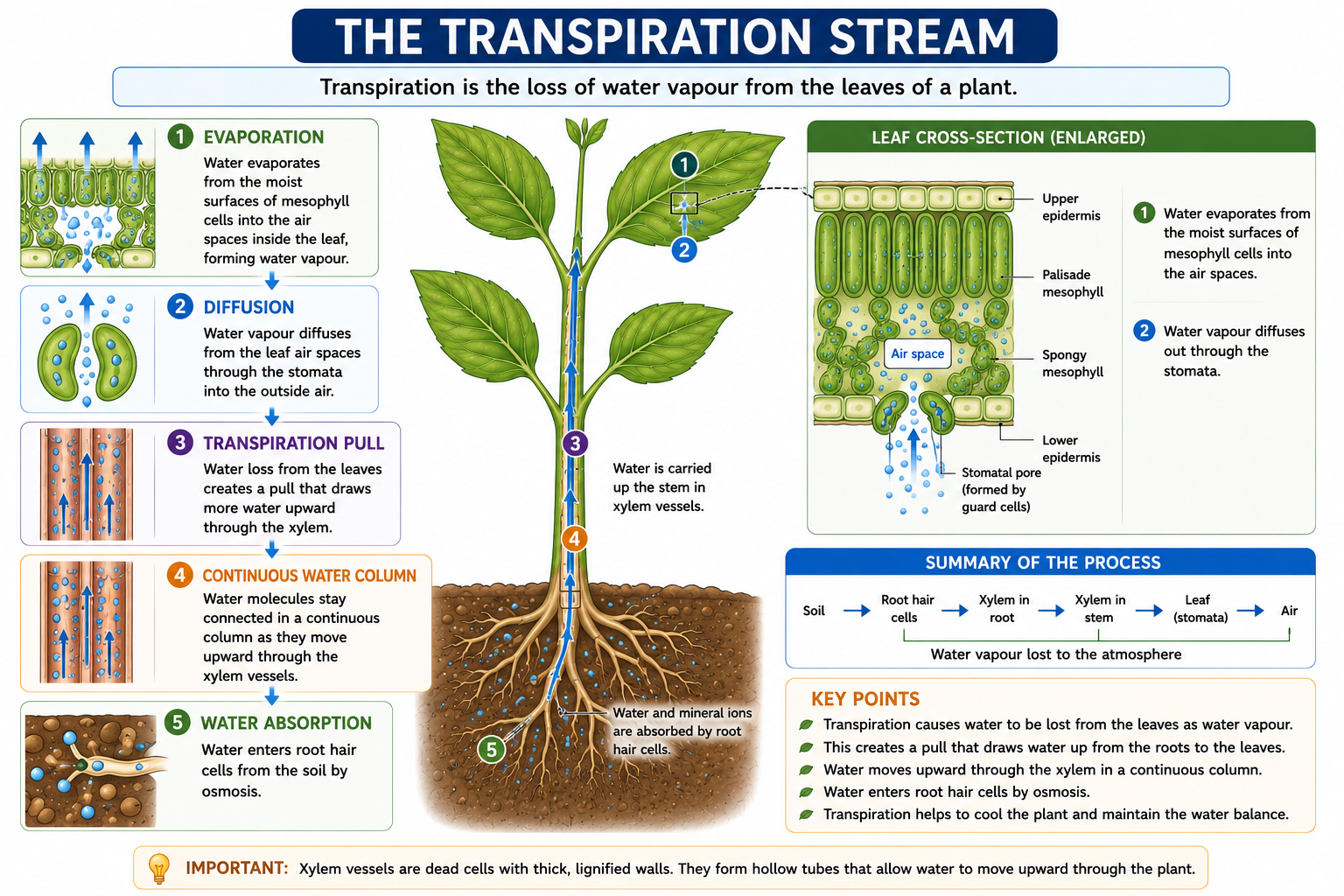
Transpiration is the loss of water vapour from the leaves of a plant.
Transpiration creates a pull that draws water upward through xylem vessels from the roots to the leaves.
Factors Affecting Transpiration
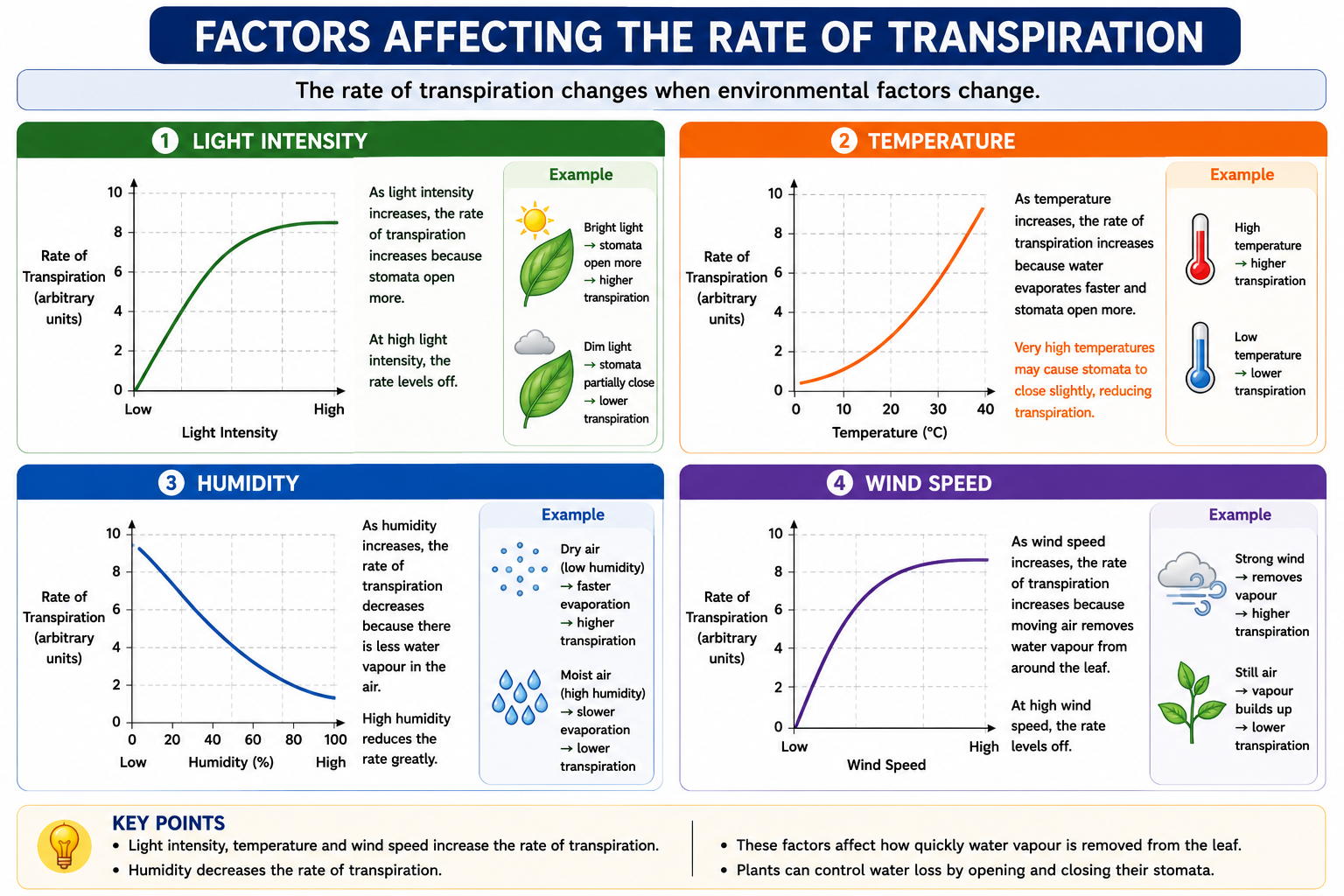
| Factor | Effect on Transpiration | Reason |
|---|---|---|
| Light intensity increases | Rate increases | Stomata open more for photosynthesis. |
| Temperature increases | Rate increases | Water evaporates faster. |
| Humidity increases | Rate decreases | Less diffusion gradient for water vapour. |
| Wind speed increases | Rate increases | Water vapour is removed from around the leaf. |
Translocation
Translocation is the movement of sucrose and amino acids in phloem from sources to sinks.
| Term | Meaning |
|---|---|
| Source | A part of the plant that releases sucrose, such as leaves during photosynthesis. |
| Sink | A part of the plant that uses or stores sucrose, such as roots, fruits or growing shoots. |
Potometer
A potometer estimates the rate of transpiration by measuring water uptake by a cut shoot.
A potometer does not measure transpiration directly. It measures water uptake, which is used as an estimate of transpiration rate.
Exam Definitions
| Term | Definition |
|---|---|
| Transpiration | Loss of water vapour from the leaves of a plant. |
| Transpiration stream | Movement of water from roots to leaves through xylem. |
| Translocation | Movement of sucrose and amino acids in phloem. |
| Source | Part of the plant that releases sucrose. |
| Sink | Part of the plant that uses or stores sucrose. |
| Osmosis | Movement of water molecules from a higher water potential to a lower water potential through a partially permeable membrane. |
Common Exam Mistakes
- Writing that xylem transports glucose. Xylem transports water and mineral ions.
- Writing that phloem transports water. Phloem transports sucrose and amino acids.
- Forgetting that mineral ions enter roots by active transport.
- Confusing transpiration with translocation.
- Saying humidity increases transpiration. High humidity decreases transpiration.
- Saying a potometer directly measures transpiration.
Exam Style Questions and Answers
1. State the function of xylem.
Xylem transports water and mineral ions from the roots to the leaves.
2. State the function of phloem.
Phloem transports sucrose and amino acids around the plant by translocation.
3. Explain how root hair cells are adapted for absorption.
They have long projections that increase surface area for absorbing water and mineral ions.
4. How does water enter root hair cells?
Water enters by osmosis.
5. How do mineral ions enter root hair cells?
Mineral ions enter by active transport, using energy from respiration.
6. Define transpiration.
Transpiration is the loss of water vapour from the leaves of a plant.
7. Explain why wind increases transpiration.
Wind removes water vapour from around the leaf, maintaining a steep diffusion gradient.
8. Explain why high humidity decreases transpiration.
The air already contains more water vapour, so the diffusion gradient from the leaf to the air is smaller.
Quick Revision Summary
- Xylem transports water and mineral ions upward.
- Phloem transports sucrose and amino acids in both directions.
- Water enters root hair cells by osmosis.
- Mineral ions enter root hair cells by active transport.
- Transpiration is water vapour loss from leaves.
- Light, temperature and wind increase transpiration.
- Humidity decreases transpiration.
- A potometer estimates transpiration by measuring water uptake.