
Cell Structure and Organisation
Learn the structure of plant and animal cells, the function of each organelle, and how specialised cells are adapted for their roles.
In This Lesson
Learning Objectives What Is a Cell? Animal Cell Structure Plant Cell Structure Plant Cell vs Animal Cell Specialised Cells Cell Organisation Exam Style QuestionsLearning Objectives
- Define a cell.
- Identify the main structures in plant and animal cells.
- Describe the function of each organelle.
- Compare plant and animal cells.
- Explain how specialised cells are adapted to their functions.
What Is a Cell?
A cell is the smallest unit of life that can carry out all life processes. All living organisms are made of cells.
Key idea: Cells are the basic building blocks of living organisms.
Animal Cell Structure
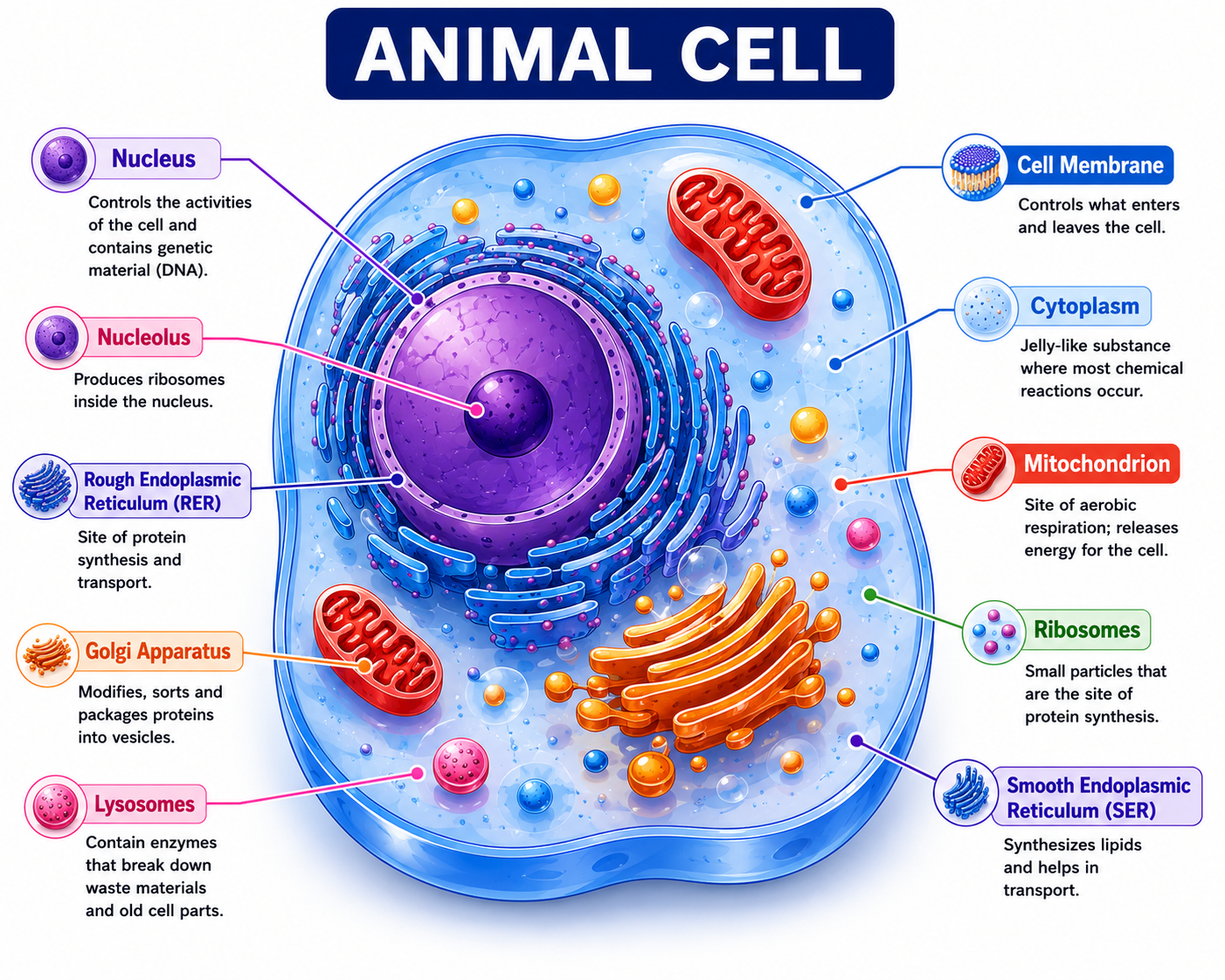
Labelled animal cell diagram.
| Organelle | Function |
|---|---|
| Nucleus | Controls cell activities and contains genetic material. |
| Cytoplasm | Where many chemical reactions take place. |
| Cell Membrane | Controls movement of substances in and out of the cell. |
| Mitochondria | Site of aerobic respiration. |
| Ribosomes | Site of protein synthesis. |
Plant Cell Structure
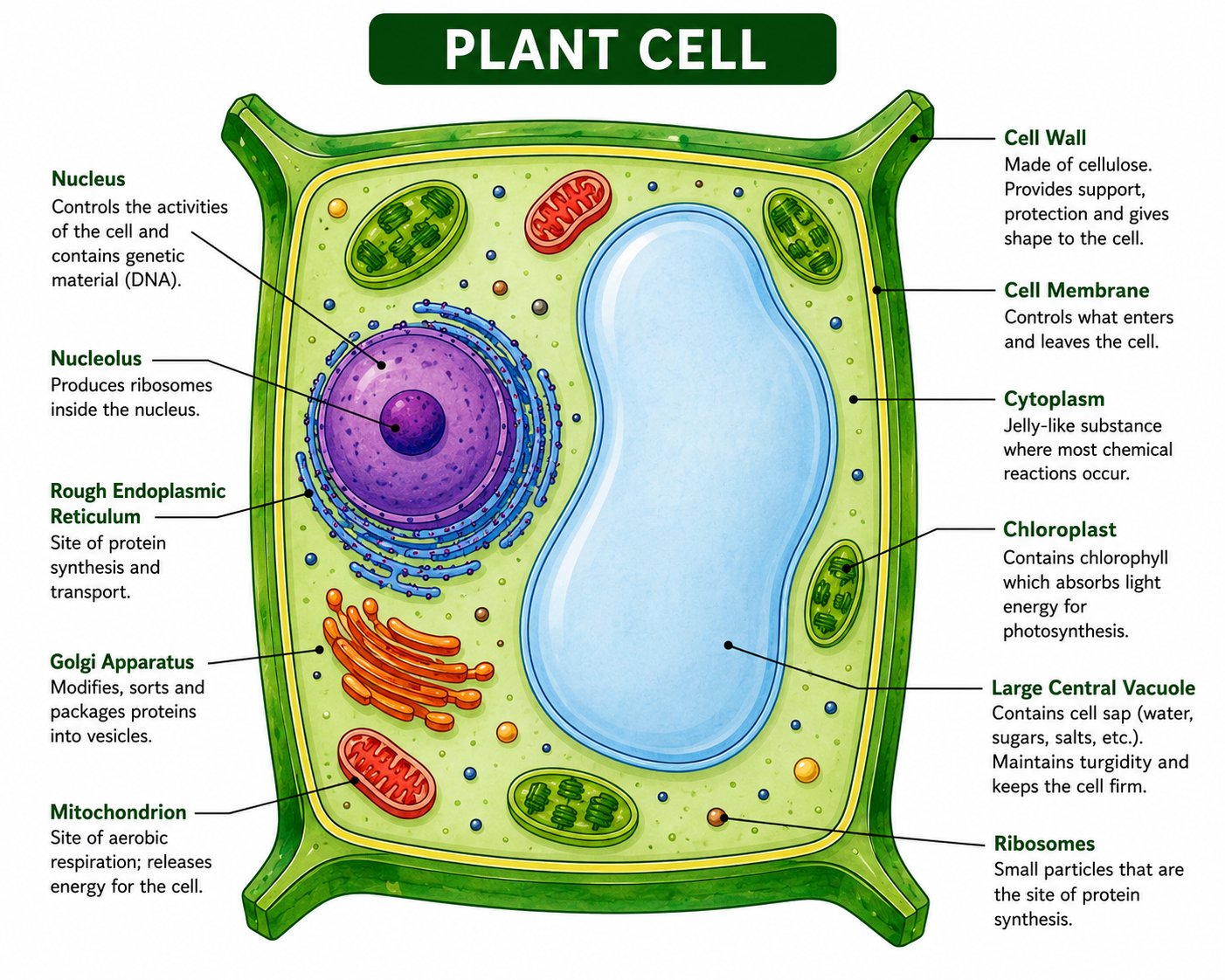
Labelled plant cell diagram.
| Structure | Function |
|---|---|
| Cell Wall | Provides support and protection. |
| Chloroplasts | Absorb light energy for photosynthesis. |
| Permanent Vacuole | Contains cell sap and keeps the cell firm. |
Plant Cell vs Animal Cell
| Feature | Plant Cell | Animal Cell |
|---|---|---|
| Nucleus | Yes | Yes |
| Cytoplasm | Yes | Yes |
| Cell Membrane | Yes | Yes |
| Cell Wall | Yes | No |
| Chloroplasts | Yes | No |
| Large Vacuole | Yes | No |
Remember: Plant cells have a cell wall, chloroplasts and a large permanent vacuole. Animal cells do not.
Specialised Cells
Root Hair Cell
Absorbs water and mineral ions. It has a long extension to increase surface area.
Red Blood Cell
Transports oxygen. It has haemoglobin and a biconcave shape.
Nerve Cell
Transmits electrical impulses using a long axon.
Sperm Cell
Has a tail for movement and many mitochondria for energy.
Cell Organisation
Cell → Tissue → Organ → Organ System → Organism
Common Exam Mistakes
- Confusing cell wall with cell membrane.
- Saying animal cells have chloroplasts.
- Forgetting mitochondria are the site of aerobic respiration.
- Mixing up ribosomes and nucleus functions.
Exam Style Questions
- Name two structures found in plant cells but not animal cells.
- State the function of mitochondria.
- Explain how a root hair cell is adapted for absorption.
- Describe one difference between a plant cell and an animal cell.
- Put these in order: organ, tissue, cell, organism, organ system.
Answers:
- Cell wall and chloroplasts.
- Mitochondria are the site of aerobic respiration.
- It has a long extension to increase surface area for absorption.
- Plant cells have a cell wall, while animal cells do not.
- Cell → Tissue → Organ → Organ System → Organism.
Quick Revision Summary
- Nucleus: controls cell activities.
- Cytoplasm: chemical reactions happen here.
- Cell membrane: controls entry and exit.
- Mitochondria: aerobic respiration.
- Ribosomes: protein synthesis.
- Chloroplasts: photosynthesis.
- Cell wall: support and protection.
- Vacuole: stores cell sap.