
Movement of Substances
Learn how substances move into and out of cells through diffusion, osmosis and active transport.
Introduction
Living cells constantly exchange substances with their surroundings. Oxygen, water, mineral ions, glucose and waste products move into and out of cells through different transport mechanisms. Understanding these processes is essential for respiration, nutrition and homeostasis.
What Is Diffusion?
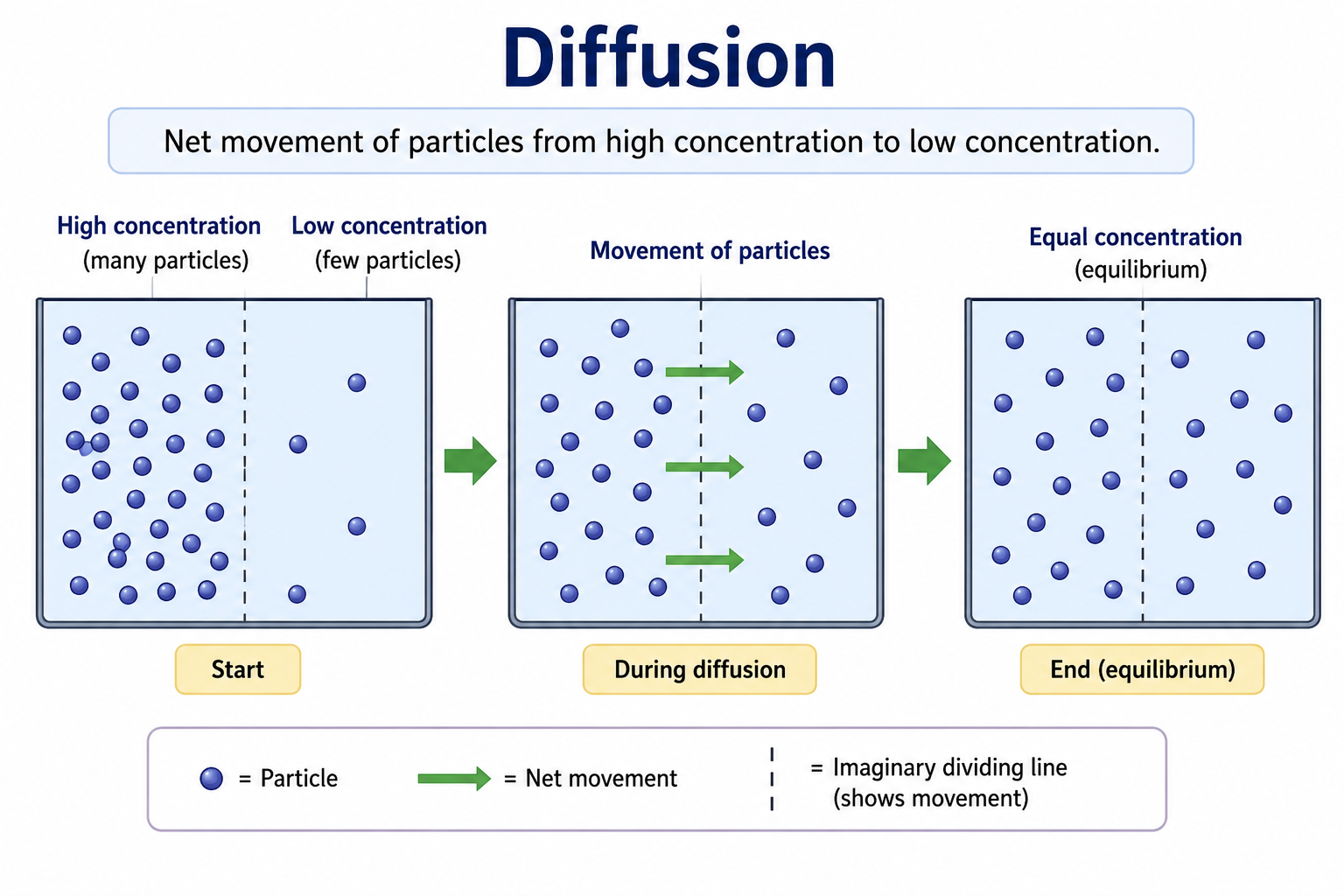
Diffusion is the net movement of particles from a region of higher concentration to a region of lower concentration.
- Oxygen diffuses from the lungs into the blood.
- Carbon dioxide diffuses from the blood into the lungs.
- Oxygen diffuses into body cells.
Factors Affecting Diffusion
| Factor | Effect |
|---|---|
| Temperature | Higher temperature increases diffusion rate. |
| Surface Area | Larger surface area increases diffusion. |
| Concentration Gradient | Greater difference increases diffusion. |
| Distance | Shorter distance increases diffusion. |
What Is Osmosis?
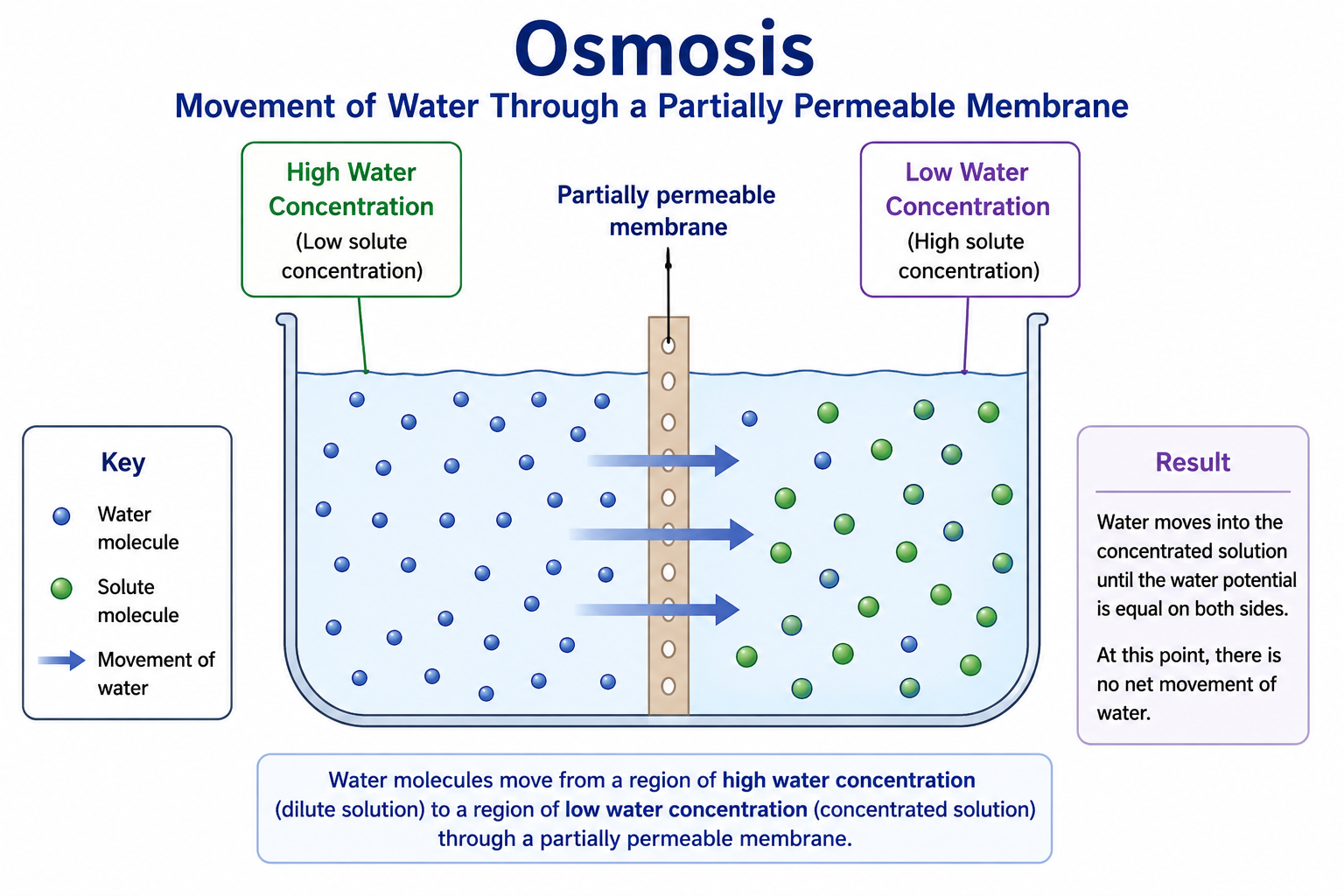
Osmosis is the net movement of water molecules from a region of higher water potential to a region of lower water potential through a partially permeable membrane.
Osmosis in Plant Cells
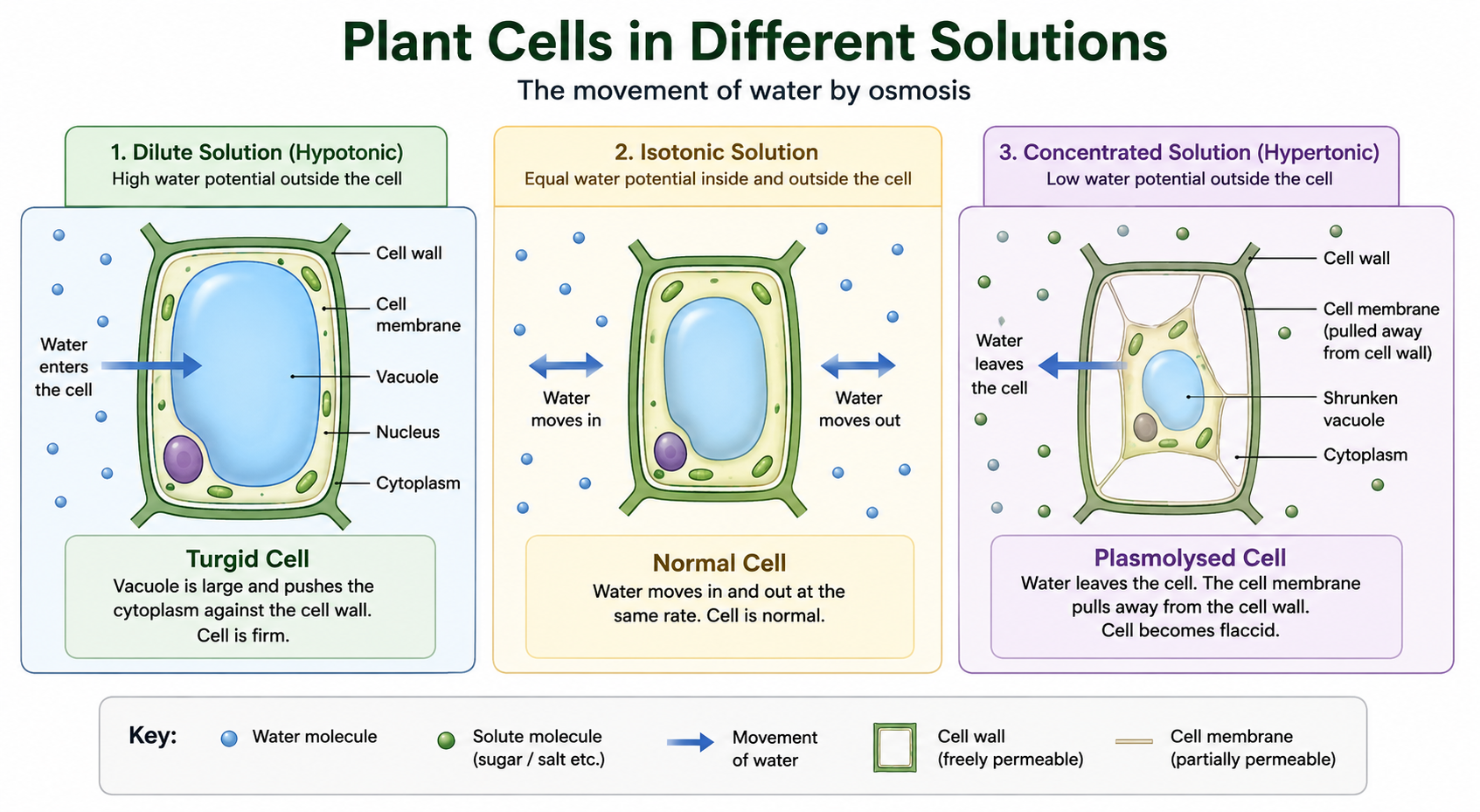
Plant Cell in a Dilute Solution
Water enters the cell. The vacuole expands and the cell becomes turgid.
Plant Cell in a Concentrated Solution
Water leaves the cell. The cell membrane pulls away from the cell wall. This process is called plasmolysis.
Osmosis in Animal Cells
Animal cells do not have a cell wall.
- In a dilute solution, water enters and the cell may burst.
- In a concentrated solution, water leaves and the cell shrinks.
What Is Active Transport?
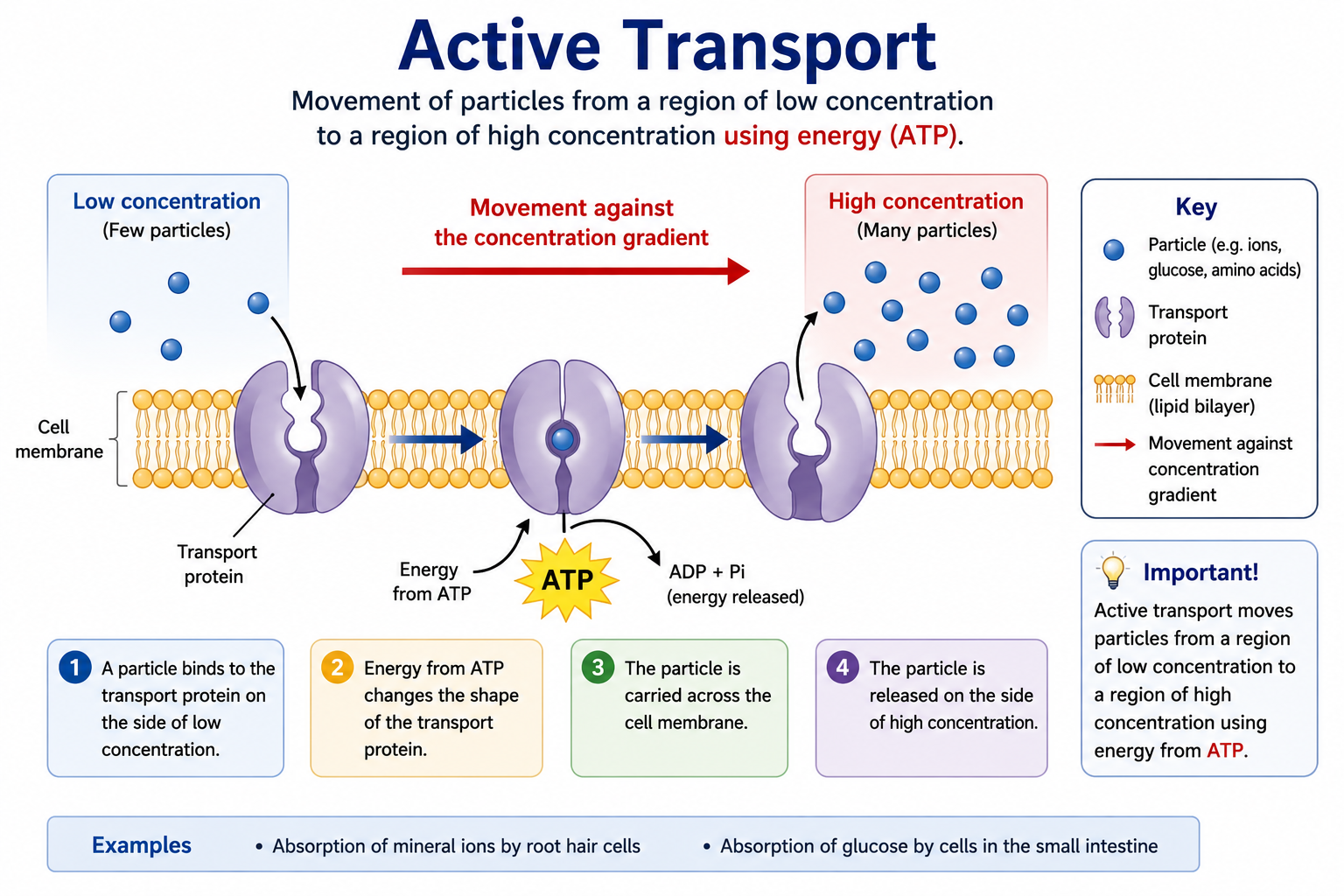
Active transport is the movement of particles from a region of lower concentration to a region of higher concentration using energy from respiration.
- Root hair cells absorb mineral ions using active transport.
- The small intestine absorbs glucose using active transport.
Diffusion vs Osmosis vs Active Transport
| Feature | Diffusion | Osmosis | Active Transport |
|---|---|---|---|
| Energy Required | No | No | Yes |
| Membrane Needed | No | Yes | Yes |
| Water Only | No | Yes | No |
| Direction | High → Low | High Water → Low Water | Low → High |
Common Exam Mistakes
- Writing water diffuses instead of water moves by osmosis.
- Forgetting that active transport requires energy.
- Confusing osmosis with diffusion.
- Forgetting the partially permeable membrane.
Exam Style Questions
- Define diffusion.
- State two factors that increase diffusion rate.
- Explain why root hair cells use active transport.
- Describe what happens to a plant cell in a concentrated salt solution.
- Compare diffusion and active transport.
Answers
- Net movement of particles from high concentration to low concentration.
- Higher temperature and larger surface area.
- Mineral ions move against the concentration gradient.
- Water leaves the cell and plasmolysis occurs.
- Active transport requires energy while diffusion does not.
Quick Revision Summary
- Diffusion = High concentration → Low concentration.
- Osmosis = Movement of water through a partially permeable membrane.
- Active Transport = Low concentration → High concentration using ATP.
- Osmosis involves water only.
- Active transport requires energy.
- Root hair cells use active transport.
- Plant cells become turgid in dilute solutions.