
Enzymes
Learn what enzymes are, how they work, and how temperature, pH, enzyme concentration and substrate concentration affect enzyme activity.
Introduction
Enzymes are biological catalysts that speed up chemical reactions in living organisms. They are important because many reactions in cells would happen too slowly without them. Enzymes help with digestion, respiration, growth, repair and many other life processes.
Learning Objectives
- Define enzymes as biological catalysts.
- Explain how enzymes work using the lock and key model.
- Describe the role of the active site.
- Explain how temperature affects enzyme activity.
- Explain how pH affects enzyme activity.
- Identify common digestive enzymes and their substrates.
What Are Enzymes?
Enzymes are proteins that act as biological catalysts. A catalyst is a substance that speeds up a chemical reaction without being used up in the reaction.
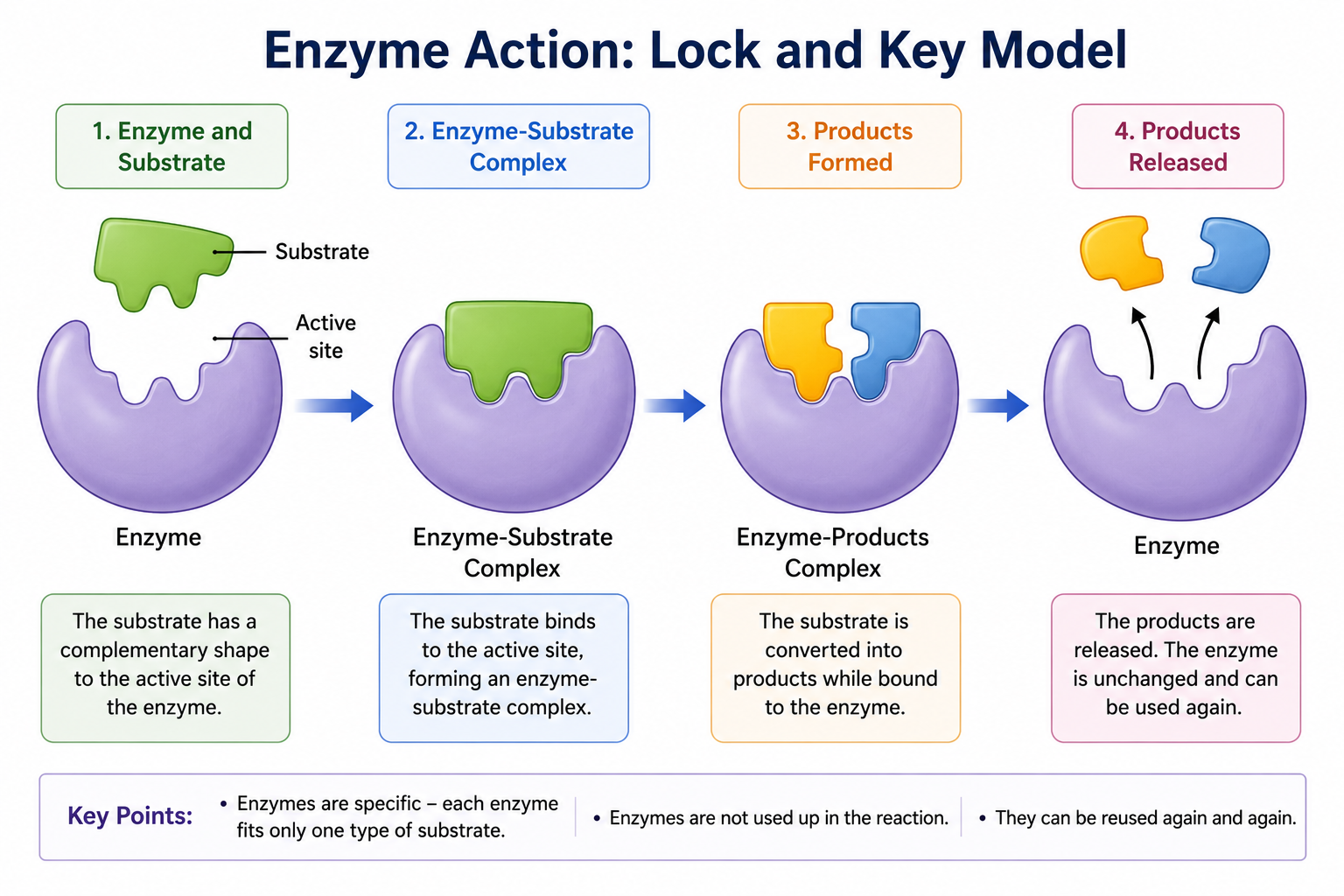
The Lock and Key Model
Each enzyme has an active site with a specific shape. Only a substrate with a complementary shape can fit into the active site. This forms an enzyme-substrate complex. The substrate is then converted into products, and the enzyme can be used again.
Important Enzyme Terms
| Term | Meaning |
|---|---|
| Enzyme | A protein that speeds up biological reactions. |
| Substrate | The molecule that an enzyme acts on. |
| Active Site | The part of the enzyme where the substrate binds. |
| Products | The substances formed after the reaction. |
| Denaturation | When the enzyme changes shape and can no longer work properly. |
Factors Affecting Enzyme Activity
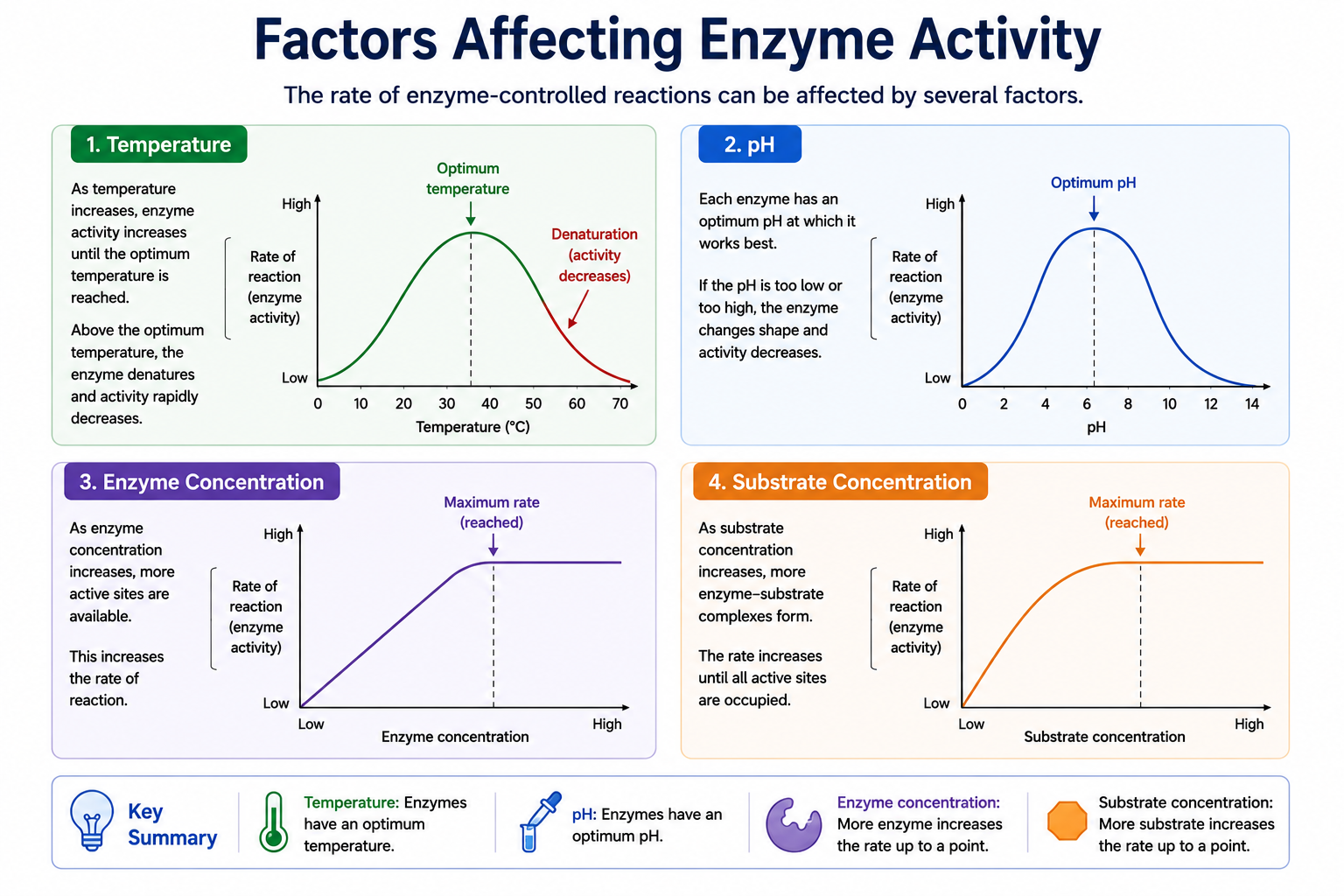
The rate of enzyme-controlled reactions can be affected by several factors, including temperature, pH, enzyme concentration and substrate concentration.
Temperature and Enzymes
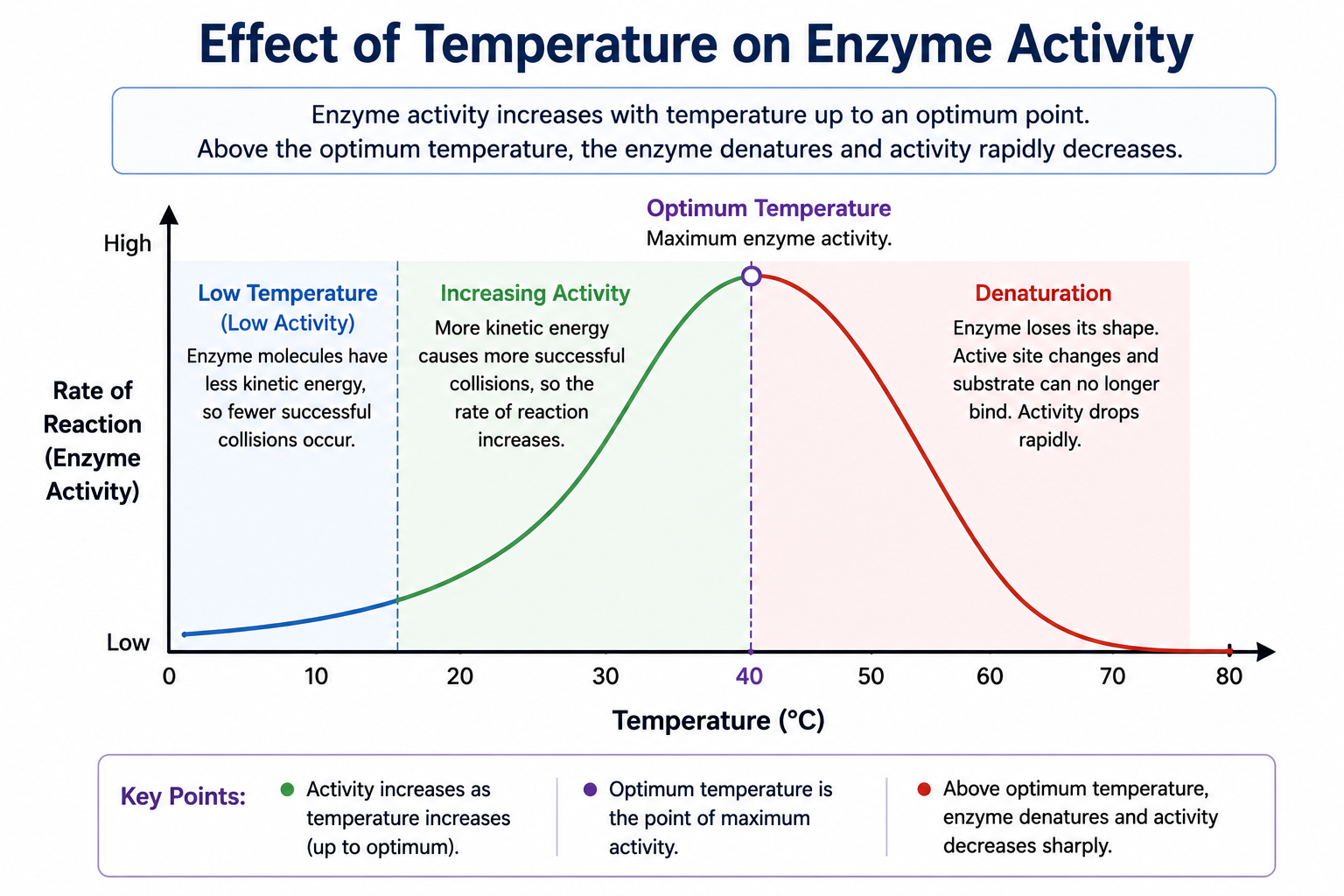
At low temperatures, enzymes and substrates have less kinetic energy, so there are fewer successful collisions. As temperature increases, enzyme activity increases until the optimum temperature is reached.
Above the optimum temperature, the enzyme changes shape. The active site no longer fits the substrate, so the enzyme becomes denatured and the reaction rate falls rapidly.
pH and Enzymes
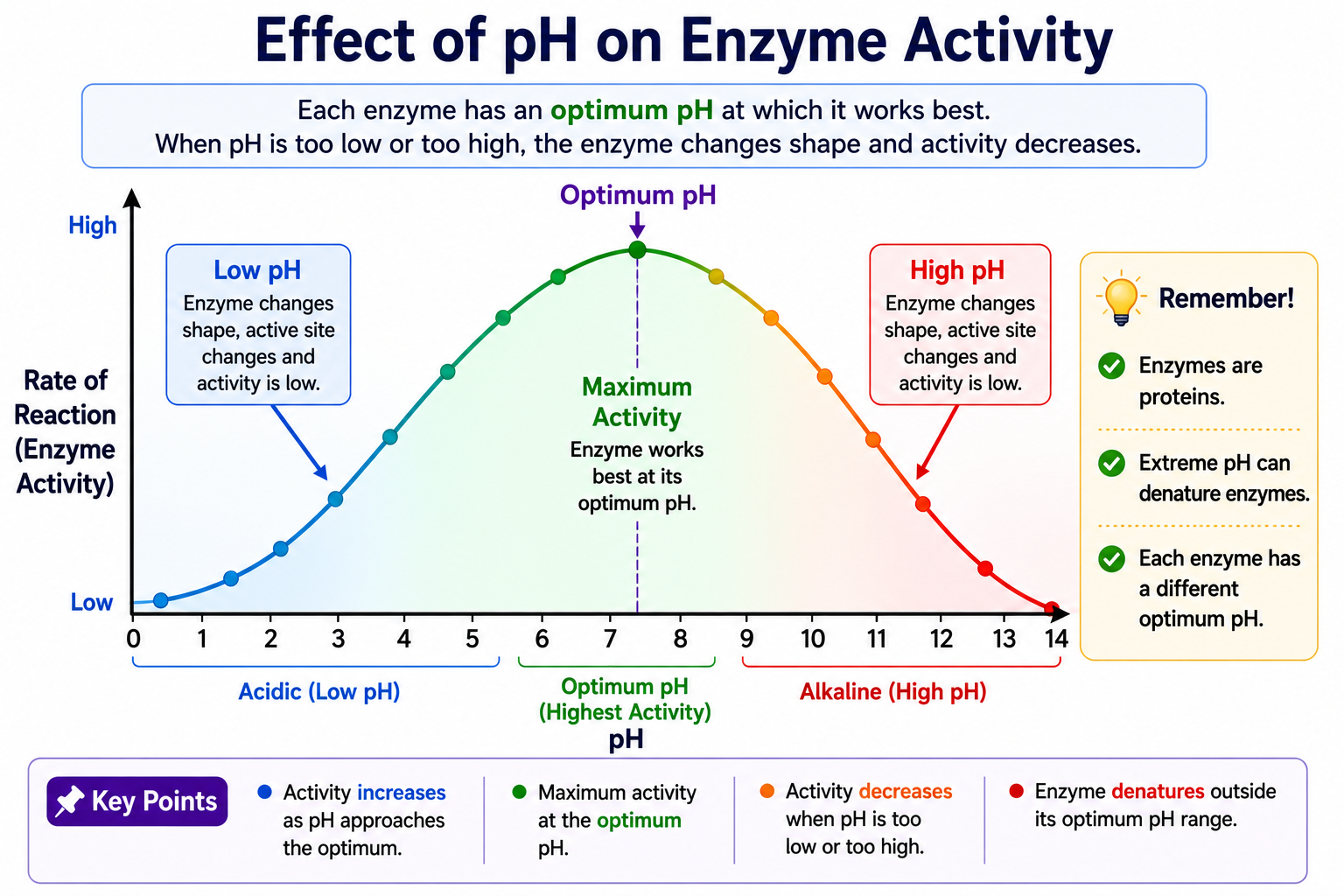
Each enzyme has an optimum pH at which it works best. If the pH is too low or too high, the enzyme changes shape and its activity decreases. Extreme pH values can denature enzymes.
Digestive Enzymes
Digestive enzymes break large food molecules into smaller soluble molecules that can be absorbed into the blood.
| Enzyme | Substrate | Product |
|---|---|---|
| Amylase | Starch | Maltose |
| Protease | Protein | Amino acids |
| Lipase | Lipids | Fatty acids and glycerol |
Enzyme Concentration
Increasing enzyme concentration usually increases the rate of reaction because there are more active sites available. However, the rate may eventually level off if there is not enough substrate.
Substrate Concentration
Increasing substrate concentration increases the rate of reaction at first because more enzyme-substrate complexes can form. Eventually, all active sites become occupied, so the rate reaches a maximum.
Common Exam Mistakes
- Saying enzymes are living things.
- Forgetting that enzymes are proteins.
- Writing that enzymes are used up in reactions.
- Saying high temperature always increases enzyme activity.
- Forgetting that denaturation changes the shape of the active site.
- Confusing substrate with product.
Exam Style Questions
- Define the term enzyme.
- What is the function of the active site?
- Explain the lock and key model.
- Describe how temperature affects enzyme activity.
- Explain what happens when an enzyme becomes denatured.
- Name the enzyme that breaks down starch.
Answers
- An enzyme is a protein that acts as a biological catalyst.
- The active site is where the substrate binds to the enzyme.
- The substrate has a complementary shape to the active site and forms an enzyme-substrate complex.
- Activity increases up to the optimum temperature, then decreases rapidly as the enzyme denatures.
- The active site changes shape, so the substrate can no longer fit.
- Amylase.
Quick Revision Summary
- Enzymes are proteins.
- Enzymes act as biological catalysts.
- Enzymes are not used up in reactions.
- The active site has a specific shape.
- The substrate fits into the active site.
- High temperature can denature enzymes.
- Each enzyme has an optimum pH.
- Amylase breaks down starch.
- Protease breaks down proteins.
- Lipase breaks down lipids.