
IGCSE Biology: Plant Nutrition
Complete Cambridge IGCSE Biology guide covering photosynthesis, leaf structure, starch testing, limiting factors, and mineral deficiency in plants.
Learning Objectives
Define photosynthesis clearly.
Write the word and symbol equations for photosynthesis.
Describe how leaf structure is adapted for photosynthesis.
Explain how plants use glucose.
Describe the test for starch in a leaf.
Explain limiting factors of photosynthesis.
Describe nitrate and magnesium deficiency symptoms.
Photosynthesis Overview
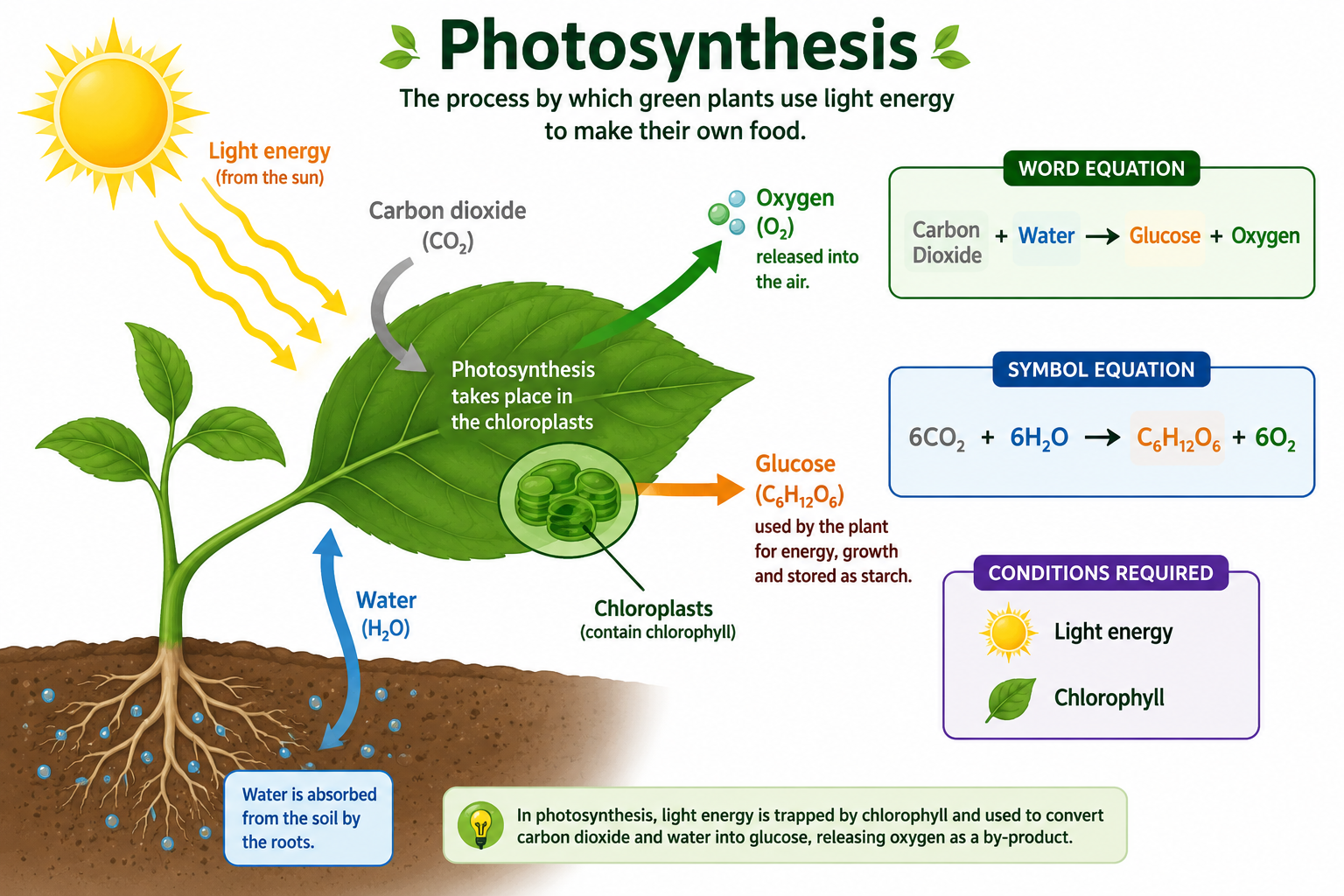
Photosynthesis is the process by which green plants make glucose from carbon dioxide and water using light energy absorbed by chlorophyll.
Word equation:
Carbon dioxide + Water → Glucose + Oxygen
Symbol equation:
6CO₂ + 6H₂O → C₆H₁₂O₆ + 6O₂
Carbon dioxide + Water → Glucose + Oxygen
Symbol equation:
6CO₂ + 6H₂O → C₆H₁₂O₆ + 6O₂
Exam Definitions
| Term | Definition |
|---|---|
| Photosynthesis | The process by which plants make glucose from carbon dioxide and water using light energy absorbed by chlorophyll. |
| Chlorophyll | A green pigment that absorbs light energy for photosynthesis. |
| Chloroplast | The cell structure where photosynthesis takes place. |
| Limiting factor | A factor that is in shortest supply and limits the rate of a reaction or process. |
| Stomata | Tiny pores in the leaf that allow gas exchange. |
Leaf Structure and Adaptations
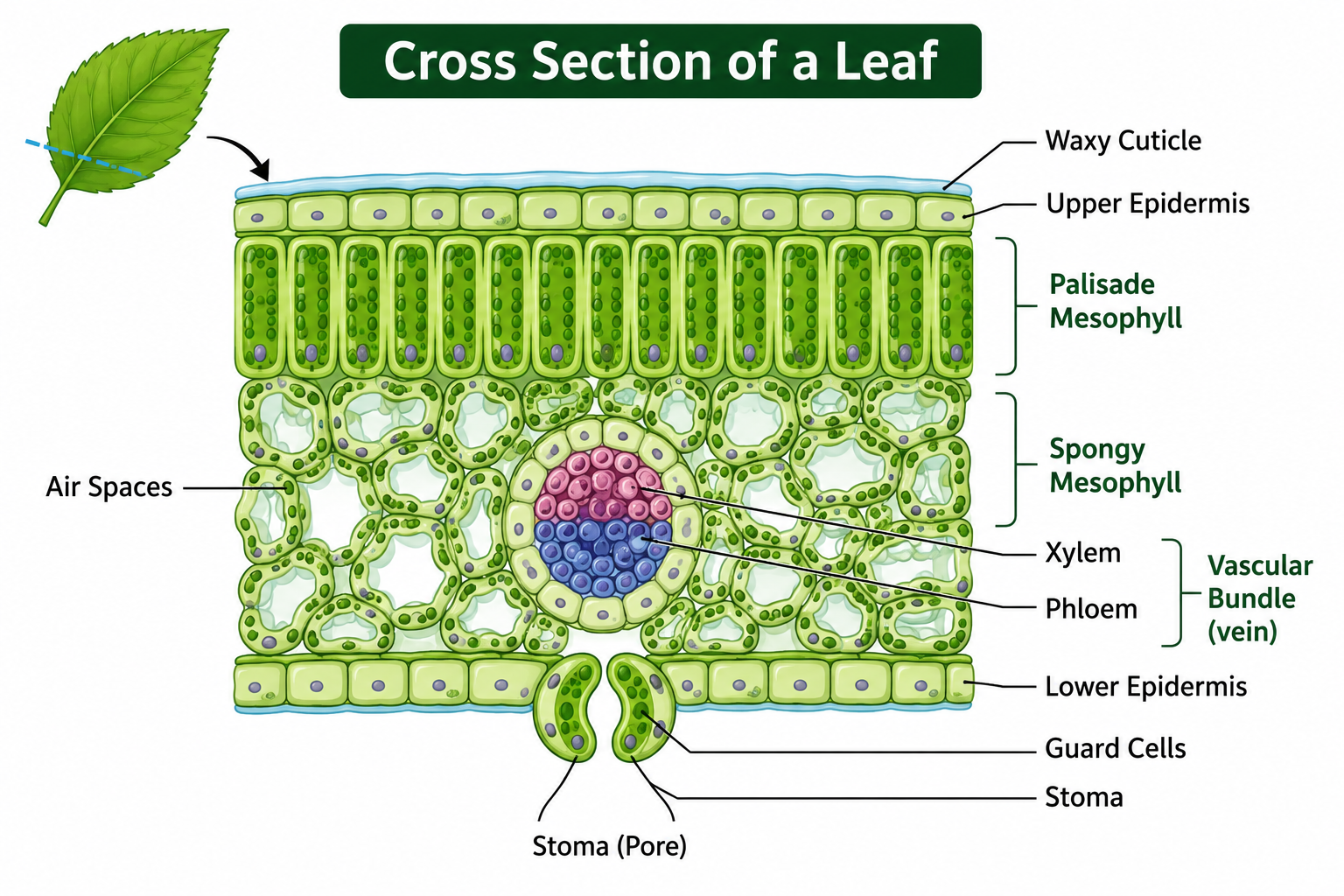
| Part | Function / Adaptation |
|---|---|
| Waxy cuticle | Reduces water loss by evaporation. |
| Upper epidermis | Transparent layer allowing light to pass through. |
| Palisade mesophyll | Contains many chloroplasts; main site of photosynthesis. |
| Spongy mesophyll | Has air spaces for diffusion of gases. |
| Stomata | Allow carbon dioxide to enter and oxygen to leave. |
| Guard cells | Control opening and closing of stomata. |
| Xylem | Transports water and mineral ions to the leaf. |
| Phloem | Transports sucrose and other assimilates away from the leaf. |
Uses of Glucose in Plants
Respiration: glucose releases energy.
Starch: glucose is stored as insoluble starch.
Cellulose: used to make plant cell walls.
Sucrose: transported around the plant in phloem.
Amino acids: made using glucose and nitrate ions.
Lipids: glucose can be converted into fats and oils.
Testing a Leaf for Starch
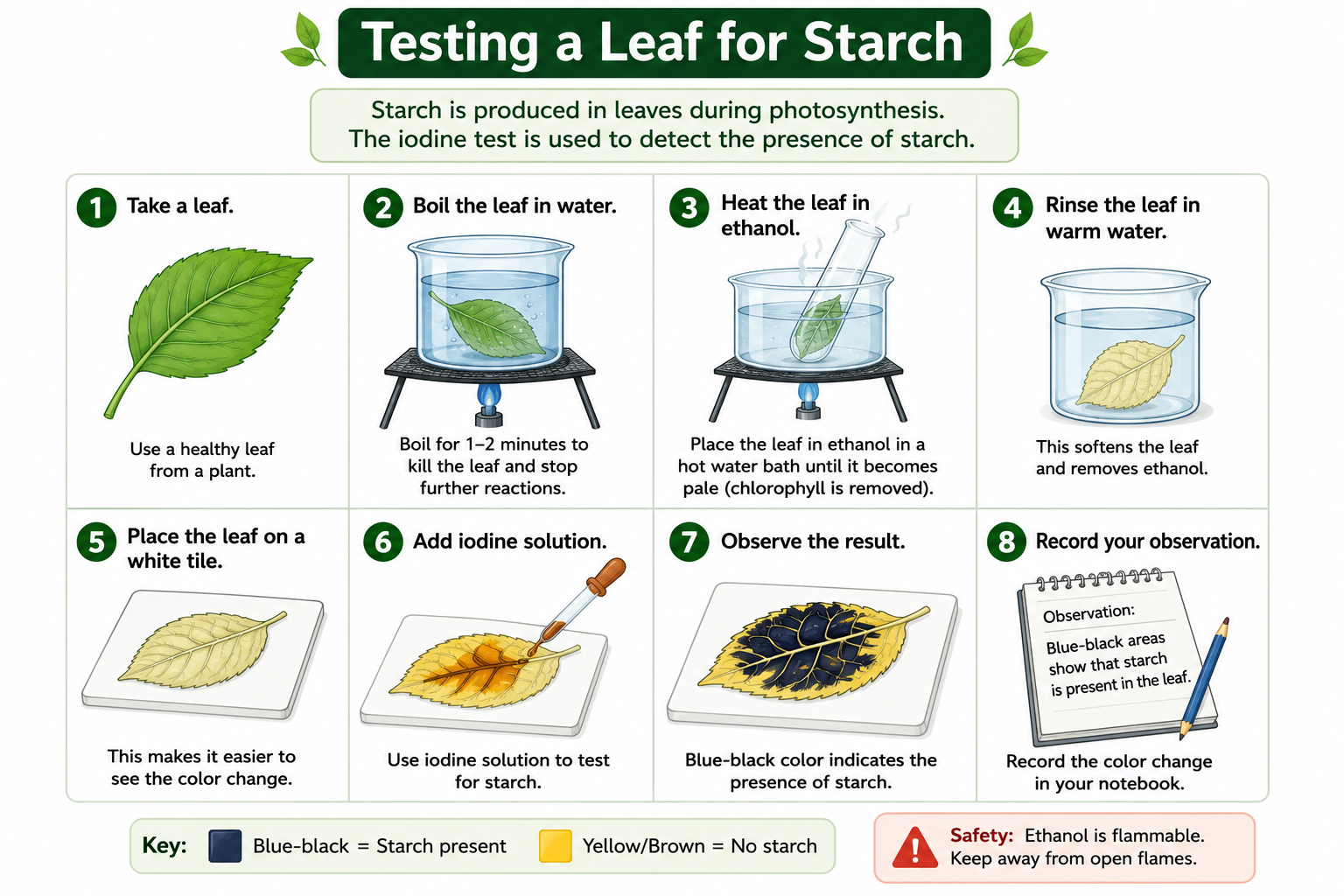
- Boil the leaf in water to kill it and stop reactions.
- Heat the leaf in ethanol using a hot water bath to remove chlorophyll.
- Rinse the leaf in warm water to soften it.
- Place the leaf on a white tile.
- Add iodine solution.
- Blue-black colour shows starch is present.
Safety: Ethanol is flammable, so it must be heated in a hot water bath, not directly over a flame.
Limiting Factors of Photosynthesis
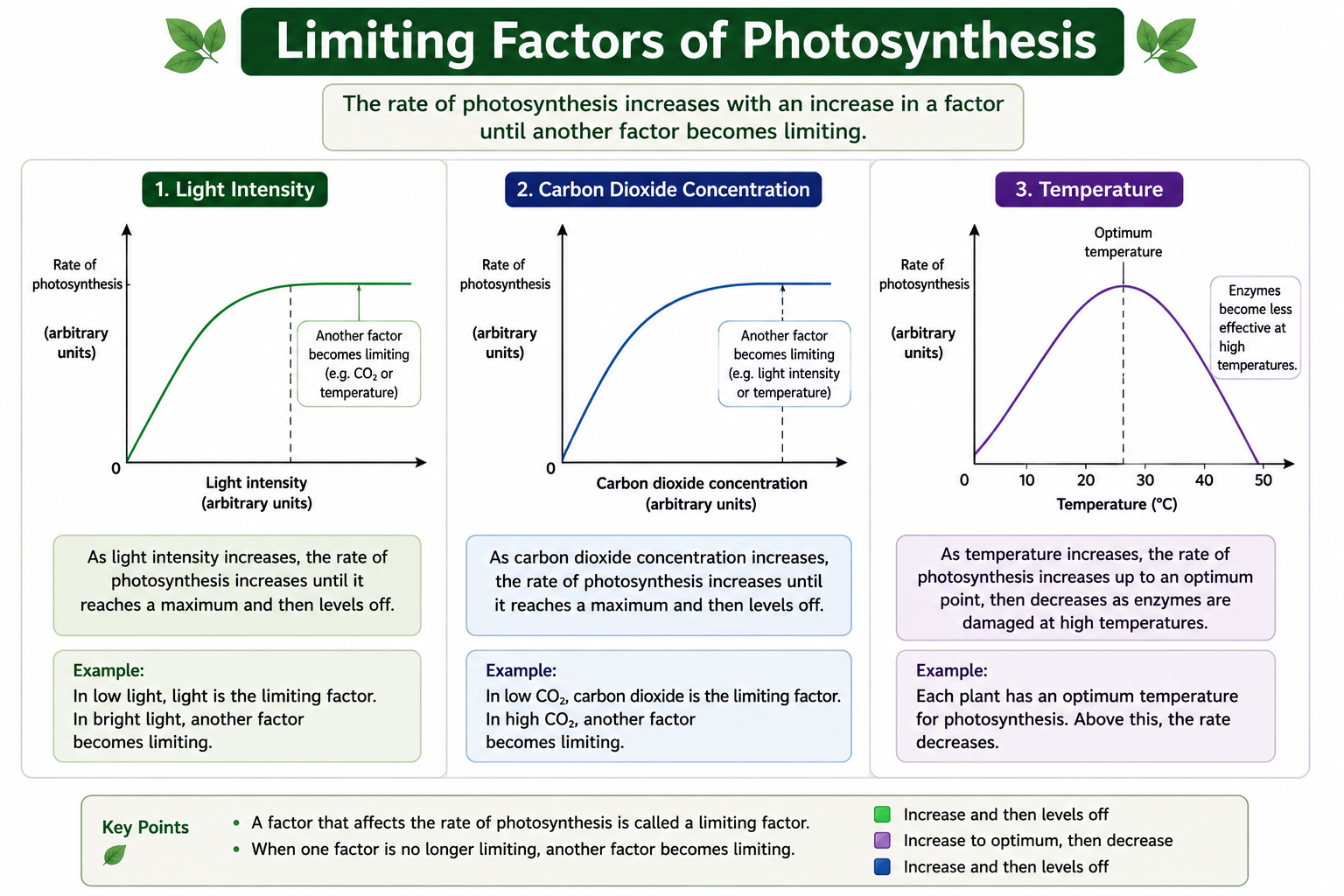
| Factor | Effect |
|---|---|
| Light intensity | Increasing light increases the rate until another factor becomes limiting. |
| Carbon dioxide concentration | Increasing carbon dioxide increases the rate until another factor becomes limiting. |
| Temperature | The rate increases up to an optimum temperature, then decreases because enzymes are denatured. |
Mineral Requirements in Plants
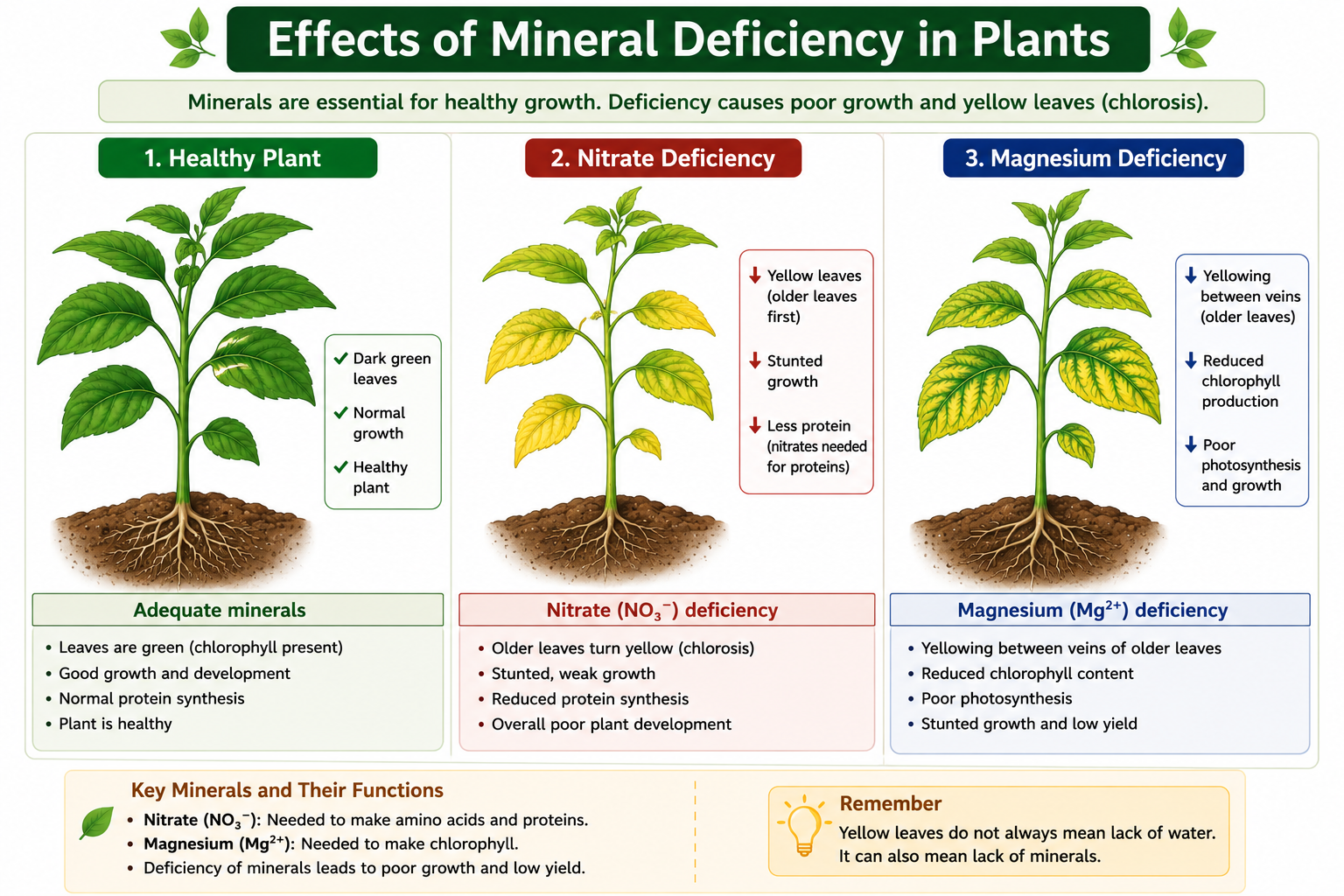
| Mineral Ion | Needed For | Deficiency Symptoms |
|---|---|---|
| Nitrate ions | Making amino acids and proteins. | Stunted growth and yellow older leaves. |
| Magnesium ions | Making chlorophyll. | Yellowing between leaf veins and reduced photosynthesis. |
Common Exam Mistakes
- Writing that plants get food from soil. Plants make glucose by photosynthesis.
- Forgetting that chlorophyll absorbs light energy.
- Confusing chloroplast with chlorophyll.
- Saying oxygen is needed for photosynthesis instead of produced by photosynthesis.
- Heating ethanol directly over a flame in the starch test.
- Not explaining the plateau in limiting factor graphs.
- Mixing up nitrate and magnesium deficiency symptoms.
Exam Style Questions
1. Define photosynthesis.
Photosynthesis is the process by which plants make glucose from carbon dioxide and water using light energy absorbed by chlorophyll.
2. State the word equation for photosynthesis.
Carbon dioxide + water → glucose + oxygen.
3. Explain why the palisade mesophyll is adapted for photosynthesis.
It contains many chloroplasts, so it absorbs more light energy for photosynthesis.
4. Why is ethanol used in the starch test?
Ethanol removes chlorophyll from the leaf so the iodine colour change can be seen clearly.
5. What colour shows that starch is present?
Blue-black.
6. Explain why the rate of photosynthesis levels off when light intensity increases.
Another factor, such as carbon dioxide concentration or temperature, becomes limiting.
7. A plant has yellow leaves and poor growth. Which mineral ion may be missing?
Nitrate ions, because they are needed to make amino acids and proteins.
8. Why does a lack of magnesium reduce photosynthesis?
Magnesium is needed to make chlorophyll, which absorbs light energy for photosynthesis.
Quick Revision Summary
- Photosynthesis makes glucose using carbon dioxide, water, light energy and chlorophyll.
- Photosynthesis happens in chloroplasts.
- Palisade mesophyll cells contain many chloroplasts.
- Stomata allow gas exchange.
- Xylem carries water and minerals to the leaf.
- Phloem carries sucrose away from the leaf.
- Iodine turns blue-black if starch is present.
- Light intensity, carbon dioxide concentration and temperature can limit photosynthesis.
- Nitrate deficiency causes poor growth.
- Magnesium deficiency reduces chlorophyll production.